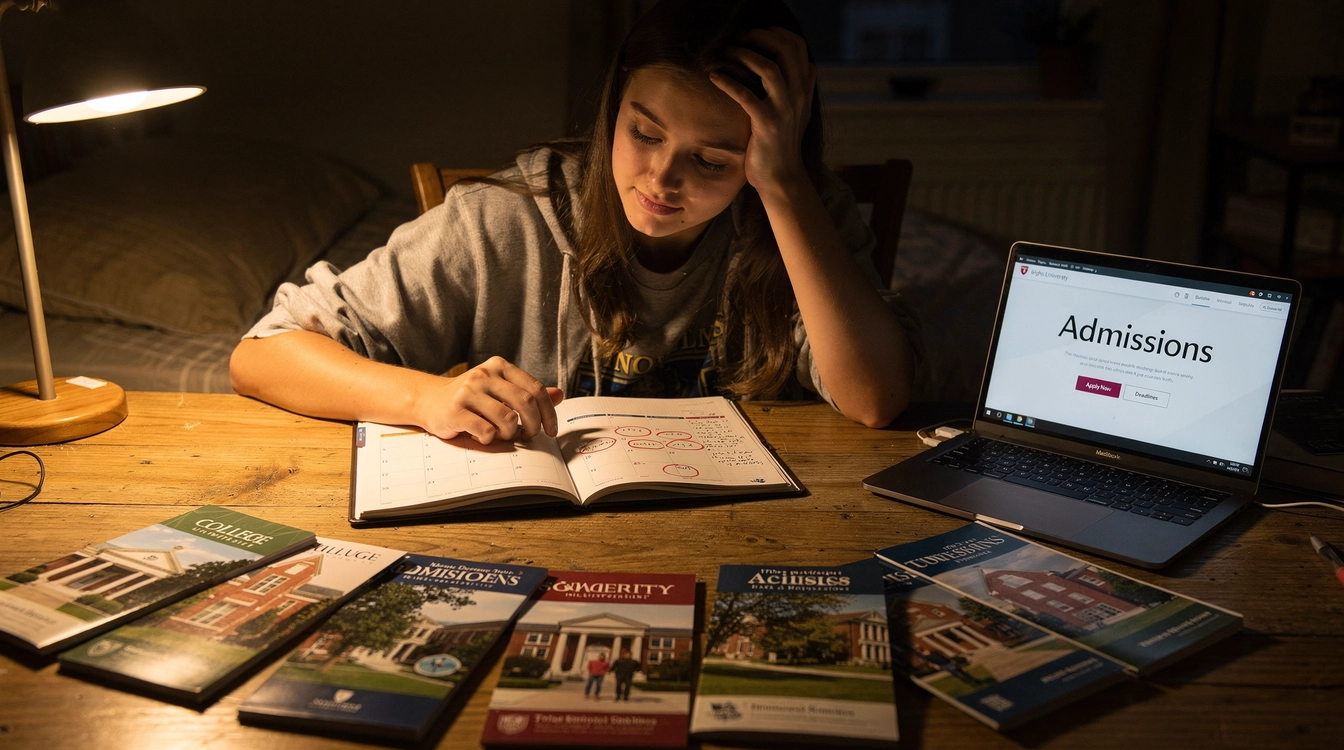
How Weather Should Influence Your College Choice
Most students spend more time comparing dining hall menus than they do thinking seriously about a campus's climate. That's a mistake with real consequences. The weather where you spend four years shapes your mood, your grades, your social life, and—if recent research is any guide—even whether you apply in the first place.
The Tour Day Trap
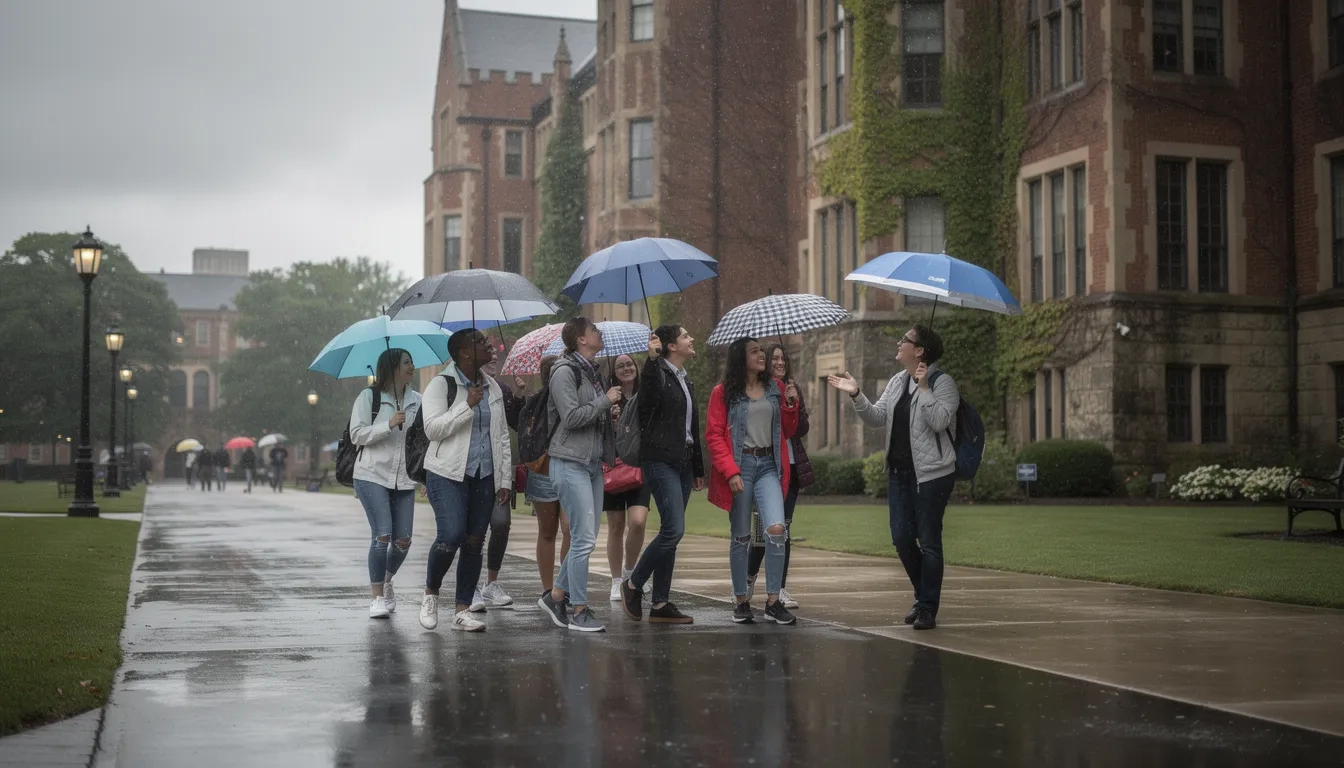
In early 2026, economists at Amherst College published a study tracking campus tour data and application rates at a selective Northeast university across eight years of records, from 2016 to 2024. The finding was hard to ignore: students who toured on a rainy day were 8.3 percent less likely to apply. Tour on an excessively hot day? 10.1 percent less likely. Cloudy and cold conditions also cut application rates.
This happens because of projection bias—the well-documented tendency to extrapolate your current emotional state onto imagined future experience. A grey, drizzly tour makes the campus feel gloomy, and your brain quietly files away "this place will feel gloomy forever."
The good news is that tour weather doesn't change where students ultimately enroll. According to the Amherst research, students who got rained out simply redirected applications elsewhere without changing the quality or type of college they attended. The tour-day effect is mostly noise. But it reveals something important: we all carry weather biases we never acknowledge.
Knowing about projection bias won't make it disappear—but it does let you ask: am I crossing off this school because of the campus, or because it was 38°F when I visited in November?
The demographic gaps in the Amherst data are worth a closer look. Rainy tours cut male application rates by 13.2 percent compared to just 4.7 percent for female visitors. Students from warmer states were 14.6 percent less likely to apply when they encountered unexpected cold. That's not a character flaw. It's human psychology. And it means being deliberate about climate early in your search—before any visit—is smarter than letting a rainy Wednesday make the decision for you.
Why Latitude Actually Matters
Once you're enrolled, climate stops being a vibe and becomes a lived daily reality. For a meaningful portion of students, that reality includes seasonal affective disorder (SAD).
Research published in the Hawaii Journal of Health & Social Welfare in December 2021 tracked 115 undergraduates across Amherst College, Washington University, and the University of Portland through a full academic year. Students from non-seasonal hometowns—places like Hawaii, southern Florida, or Southern California—showed a 1.6-point greater increase on the Seasonal Pattern Assessment Questionnaire (SPAQ) during winter months. Nearly 50 percent of those students reported measurable mood worsening by February.
Their peers who grew up in already-seasonal climates? No significant mood change at all.
This isn't about sensitivity or attitude. Seasonal light exposure literally primes your nervous system for what to expect. Students from non-seasonal hometowns averaged 619 winter sunlight hours back home; at northern universities, they were navigating environments with roughly 393. That's a physiological adjustment, not a preference mismatch.
An earlier study of 76 college students in northern New England found combined SAD and subsyndromal SAD affected approximately 32.9 percent of participants during winter—13.2 percent meeting full SAD criteria and another 19.7 percent showing subsyndromal symptoms. For those students, symptoms included fatigue, concentration failures, missed classes, and difficulty completing assignments. That last part is the academic cost most families never calculate when comparing schools.
Who Faces the Highest Risk
Not every student is equally vulnerable to climate-related mood shifts. The research points to a few clear risk factors:
- Relocation distance. Students moving from southern latitudes (below roughly 35°N) to northern universities (above 42°N) face the sharpest seasonal adjustment. Think: a student from Houston enrolling at the University of Vermont.
- No prior seasonal exposure. Students who grew up in mild winters haven't built the physiological and behavioral coping patterns their Northern-raised peers developed over years. The first winter away can be clinically significant.
- Freshman-year compounding. The transition to college already carries documented stress. Layering an unfamiliar climate onto new academic demands, a new social environment, and no existing support network creates real pressure. First-year students from non-seasonal backgrounds are the population most likely to develop SAD symptoms during their initial winter semester.
A few other factors worth knowing: SAD affects women more frequently than men across most studies, students with personal or family history of depression face elevated risk in low-sunlight environments, and anyone who relies heavily on outdoor activity for stress relief may find a cold, snowy winter particularly disruptive.
What Climate Does to Daily Life
Mood disorders are one end of the spectrum. But climate shapes day-to-day campus life in less dramatic ways too.
Outdoor recreation access is one of the most underrated factors in college satisfaction. Research reviewed in the Journal of Outdoor Recreation, Education, and Leadership linked campus outdoor programs to better academic performance, lower anxiety, easier social connection, and smoother college transitions. If you hike, run, bike, or simply need to be outside regularly, a campus with eight frozen months changes your options in ways that compound over four years.
Heat is its own problem. A 2024 systematic review in PLOS Climate found that cumulative exposure to urban heat impairs students' learning capacity, with high-performing students showing some of the steepest cognitive impacts across a semester. A campus in Phoenix in August is running a different cognitive environment than the same school in October.
Here's a quick breakdown of what each climate type brings with it:
| Climate Type | Common Challenges | Common Advantages |
|---|---|---|
| Northern (Vermont, Minnesota) | SAD risk, limited outdoor time Nov–Mar | Distinct seasons, winter sports, vivid fall |
| Moderate (North Carolina, Oregon) | Rainy winters, occasional heat waves | Year-round outdoor access, mild transitions |
| Sunny/Arid (Arizona, Southern California) | Summer heat, dry air, wildfire smoke | High sunlight hours, consistent outdoor activity |
| Southern Humid (Florida, Louisiana) | Hurricane disruption, intense humidity | Warm winters, low SAD risk |
The right answer depends entirely on who you are. A student who skied through high school and wants to keep skiing should apply to different schools than someone who surfs year-round. That sounds obvious. But most college counselors never ask about it.
The Cost Nobody's Accounting For
The elephant in the room is that weather is consistently underweighted in college decisions, and the consequences show up in ways that matter.
Seasonal depression can tank a semester. A 3.8 GPA in October can slide toward a 2.9 by March if a student from Miami is grinding through their first Minnesota February without adequate support or preparation. That academic dip is real, recoverable for most, but damaging if it hits during a key semester for graduate school applications or internship recruiting.
Universities in northern climates often have strong counseling and light therapy resources specifically because they've watched this pattern for decades. Penn State Behrend, for instance, provides light therapy lamp access and seasonal depression programming through its counseling center. Asking a school about those resources during your research isn't excessive—it's practical due diligence.
The inverse also holds. Students who need distinct seasons, who find warm weather year-round somehow deadening, or who get their best energy from cold-air runs in October should not romanticize a Florida university just because of its rankings.
A Framework for Making the Call
Weather shouldn't be the only factor. But here's a structured way to actually weigh it:
- Know your baseline. Have you struggled with low mood, fatigue, or motivation in past winters? If yes, northern universities need extra scrutiny—not a veto, but an honest look.
- Research sunlight hours, not just temperature. Portland, Oregon (roughly 142 sunny days per year) gets far less winter sunlight than Denver (around 300 sunny days), even though Denver runs colder. Pull NOAA data for any city you're seriously considering.
- Ask schools directly about mental health infrastructure. Does the school offer light therapy lamps? Seasonal depression programming? A single admissions call can surface this.
- Visit in winter if possible. If you're serious about a northern school, visit in January or February, not just during April's open house. That's the version of campus you'll actually need to thrive in for four months every year.
- Model your outdoor life. List your three most important physical or social activities. For each one, ask: can I do this nine months of the year at this school? If the answer is no across the board, that's not a preference—it's a wellbeing risk.
- Don't let a tour day decide. If you visited a school you otherwise love in bad weather, go back. Or at minimum, sit with what we know: tour weather is statistically unrelated to whether you'll actually be happy there.
Bottom Line
- Don't let a single bad-weather visit rule out a school you'd otherwise love. The Amherst NBER research is clear: tour-day weather triggers projection bias but doesn't predict your four-year experience.
- Take latitude seriously if you're from a warm climate. Moving from the Sun Belt to New England is a physiological adjustment, and nearly half of students from non-seasonal backgrounds show measurable mood worsening by February.
- Use annual sunlight hours as your primary climate metric, not just average temperature. NOAA sunshine data is free, specific, and far more useful than how cold a campus feels in November.
- Ask schools about seasonal mental health resources. Schools with robust winter programming already know their students need it—and that's a feature, not a warning sign.
- Be deliberate. Climate is a four-year daily reality, not a tour-day impression.
Frequently Asked Questions
Does weather during a campus tour actually affect which college you choose?
Yes, measurably. Amherst College economists found that students who toured on rainy days were 8.3 percent less likely to apply, with excessively hot days producing a 10.1 percent drop in application rates. The effect is driven by projection bias—you unconsciously extrapolate a temporary bad mood onto imagined future experience. Notably, tour weather doesn't change where students ultimately enroll; it just shifts applications between schools of similar academic quality.
Can relocating to a colder, darker climate cause depression in college students?
It can, particularly for students from warm or consistently sunny climates. Research tracking 115 undergraduates found that students from non-seasonal hometowns experienced a 1.6-point greater increase in seasonal mood symptoms during winter compared to students who grew up in seasonal climates. Nearly half of non-seasonal students showed measurable mood worsening by February. This isn't universal, but it's common enough to warrant honest self-assessment before committing to a northern school.
Is seasonal affective disorder actually common in college students?
More common than most students expect. A study of college students in northern New England found combined SAD and subsyndromal SAD affected roughly 32.9 percent of participants during winter months. SAD is more prevalent among women, students from lower latitudes, and first-year students navigating a new environment without established support systems around them.
What's the most practical way to research a school's climate before visiting?
Check NOAA's database for annual sunshine hours and average winter temperatures for the city. Sunshine hours matter more than temperature alone—Portland, Oregon averages roughly 142 sunny days per year compared to Denver's 300, despite Denver running significantly colder. Then check the school's student health or counseling center website to see whether they offer light therapy or seasonal wellness programming.
Should students from warm climates avoid northern universities entirely?
No. Plenty of students from Florida, California, and Texas thrive at schools in Minnesota or Vermont. The key factors are awareness of SAD risk, a proactive winter plan (light therapy lamp, exercise routine, early use of counseling services), and a genuine attraction to northern campus life. A school you love in every other dimension is worth the preparation. The harder situation is choosing a northern school by default and discovering the climate mismatch mid-semester.
Does heat affect academic performance in college?
Yes. A 2024 systematic review in PLOS Climate found cumulative exposure to urban heat impairs students' learning capacity over a semester, with high-performing students showing some of the steepest cognitive impacts. For students at universities in hot climates, access to air-conditioned study spaces, campus walkability, and early morning class scheduling all become practical factors worth investigating during your research process.
Sources
- Bad Weather Casts Cloud Over College Application Decisions
- "Feel" as a Determinant of College Choice: Evidence from Campus Tour Weather | NBER
- Effect of Hometown Seasonality on Undergraduate Students' Risk of Developing SAD
- Seasonal affective disorder in college students: prevalence and latitude
- Cumulative Exposure to Urban Heat Can Affect the Learning Capacity of Students | PLOS Climate
- Weather Impact on College Tours: Rainy Visits Lower Enrollment