UVA vs William & Mary: Which Virginia Public Should You Actually Apply To?
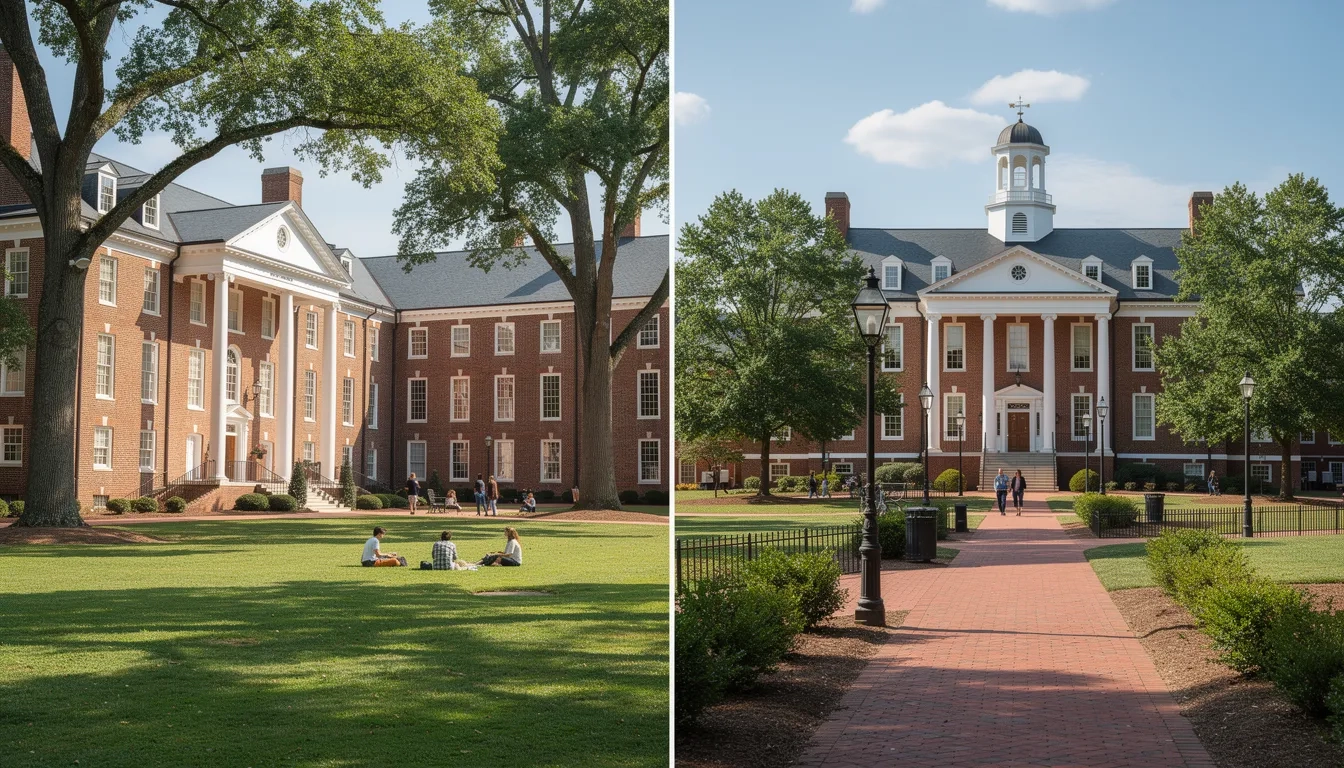
If you've spent any time in a Virginia guidance counselor's office, you've heard the pairing so often it starts to sound like one word: UVAandWilliamandMary. Both are public. Both are old, ivy-covered, and expensive to get into. Both show up on every "Public Ivy" list ever printed. And both get recommended to the same kid, in the same breath, as if they're basically interchangeable — pick whichever campus felt nicer on the tour.
They are not interchangeable. UVA and William & Mary sit about 150 miles apart on I-64, and beyond that they don't have much in common except a state legislature and a shared distaste for losing to Virginia Tech. One is a research powerhouse built around a business school people fly across the country to attend. The other is a small, intense liberal arts college that happens to be public and happens to run the oldest law school in the country. Picking between them on vibes alone is how you end up transferring sophomore year.
Let's get into what actually separates them.
The Common Misconception: "They're Both Just Virginia's Public Ivies"
The term "Public Ivy" gets thrown around like it means something specific. It doesn't, really — it's a marketing phrase, not a ranking. It was coined in 1985 by Richard Moll, a former Yale admissions officer, in a book listing public universities he thought delivered an Ivy-caliber education at a public-school price. UVA and William & Mary were both on that original list. So were Michigan, Berkeley, and UCLA. There's no committee, no cutoff score, no official designation — anyone can slap "Public Ivy" on a brochure.
The real misconception isn't that the label is meaningless (most applicants sense that). It's the assumption that because both schools wear the label, they deliver a similar experience. They don't.
UVA is a full-scale research university with roughly 17,900 undergraduates, a football stadium that seats 61,500, an engineering school, a nursing school, a top-tier business school, and a graduate population layered on top that makes the total campus feel like a small city. William & Mary enrolls about 7,000 undergrads total — smaller than many UVA departments — and has no engineering school, no b-school with a football team's worth of swagger, and a campus you can walk end to end in fifteen minutes. One is "public Ivy" in the sense of prestige-per-dollar. The other is "public Ivy" in the sense of small-college intimacy with a public price tag. Confusing the two is how a kid who wanted Amherst ends up somewhere that feels like a mid-size state flagship, or vice versa.
Head-to-Head: UVA vs William & Mary
| University of Virginia | William & Mary | |
|---|---|---|
| Founded | 1819, by Thomas Jefferson | 1693 — second-oldest college in the US |
| Undergrad enrollment | ~17,900 | ~7,060 |
| Setting | Charlottesville — college city, walkable Downtown Mall | Williamsburg — small historic town, next to Colonial Williamsburg |
| Acceptance rate (Class of 2029) | 15.6% overall (23% in-state / 12.5% out-of-state) | 37% overall |
| In-state tuition & fees (2025-26) | ~$23,900 | ~$25,700 |
| Out-of-state tuition & fees (2025-26) | ~$62,900 | ~$51,000 |
| Student-faculty ratio | 14:1 | 11:1 |
| Vibe | Big-school energy, Jeffersonian grandeur, sports-and-social scene | Small, academically intense, "nerdy in a good way" |
| Standout programs | McIntire Commerce, Batten Policy, Nursing, Engineering | Government/Political Science, Law (oldest in the US), Data Science |
| Greek life participation | ~26-28% | ~24% |
| US News National Universities rank (2026) | #26 overall, #4 public | #51 overall |
Getting In: Two Very Different Odds
This is the number that stops most families cold. For the Class of 2029, UVA received 64,457 applications and admitted just 15.6% of them — a number that's been compressing fast, down from 22.6% only four years earlier. Split it by residency and it gets sharper: in-state applicants had a 23% shot, out-of-state applicants closer to 12.5%. Apply early decision as a Virginia resident and your odds nearly double to around 29.5%; apply regular decision from out of state and you're down near 9%.
William & Mary is a different game. It admitted 37% of applicants to the Class of 2029 — in-state and out-of-state rates were identical, which is unusual for a public school with a legislative mandate to prioritize residents. That doesn't mean it's easy. The admitted middle-50% SAT range runs 1390-1520, and 79% of enrolled students ranked in the top 10% of their high school class. It's selective. It's just not UVA-in-2026 selective.
Practically: if you're a strong in-state student with a 3.9 and a 1450, W&M is a very reasonable admit and UVA is a real reach, not a match. If you're out-of-state with the same profile, treat both as reaches — but W&M's is meaningfully more forgiving.
Academics: What Each School Actually Does Best
UVA's calling card is McIntire, its undergraduate commerce school — ranked the #1 public undergraduate business program and #2 overall nationally in Poets&Quants' 2026 rankings. Getting into McIntire is its own gauntlet (students apply after two years on Grounds, and the internal admit rate is brutal), but if you clear it, the alumni network and recruiting pipeline into consulting and finance are hard to match at a public school. Beyond commerce, UVA's nursing, engineering, and Batten School of policy programs are genuinely strong, and its status as a top-tier research university means undergrads can land in real labs, not just intro sections.
William & Mary doesn't try to be that kind of school. Its reputation is built on government and political science — it has produced governors, senators, and a disproportionate number of Foreign Service officers for a school its size — and on its law school, founded in 1779, which is the oldest law school in continuous operation in the United States (Thomas Jefferson studied law there before it was formally a school). W&M has also built out a well-regarded data science program and leans hard into undergraduate research and close faculty contact; 86% of its classes have fewer than 40 students, and small seminars with tenured professors are the norm, not the exception, even freshman year.
If you want to be a face in a very good crowd, pick UVA. If you want a professor to know your name by October and still get taken seriously by grad schools and employers, pick William & Mary. Both bets are defensible. They're just different bets.
Campus and Setting: City Energy vs. Colonial Quiet
Charlottesville is a real small city — a walkable downtown mall, a live-music scene, breweries and restaurants that exist independent of the university, and enough distance from Grounds that students genuinely leave campus on weekends. UVA's architecture, designed by Jefferson himself, centers on the Lawn and the Rotunda, and there's a gravity to the place that a lot of students describe as almost civic — you feel like you're at an institution, not just a school.
Williamsburg is smaller and quieter, built around and literally adjacent to Colonial Williamsburg's historic area. It's charming in a way that some students love and others find claustrophobic by junior year — there's less to do off campus, and the town skews older and more tourist-driven than college-town. What Williamsburg gives up in nightlife it gives back in a tight-knit, walkable campus where you'll recognize most of your class by sophomore year.
Neither setting is objectively better. A student who wants a college town with texture and independence from campus life will prefer Charlottesville. A student who wants campus to feel like the center of gravity, full stop, will be more at home in Williamsburg.
Social Scene and Greek Life
Both schools have meaningful Greek systems — UVA sits around 26-28% Greek participation, W&M around 24% — but they land differently given the size difference. At UVA, Greek life is one social option among many in a large student body with club sports, a Division I athletics culture (football Saturdays are a real thing), and a big enough population that you can build a social life entirely outside the Greek system without feeling like an outsider.
At William & Mary, with a much smaller undergrad population, campus social life is more concentrated — a cappella groups, the improv scene, intramurals, and a heavily involved residential culture matter more relative to Greek life than they do at UVA. Neither school runs the stereotypical "party school" reputation; both trend toward students who care about their GPA on a Friday night, W&M more so.
Cost: Where the Math Actually Flips
Here's the part that surprises people: for out-of-state families, William & Mary is meaningfully cheaper. 2025-26 out-of-state tuition and fees run about $51,000 at W&M versus roughly $62,900 at UVA — over $11,000 a year, or $45,000+ across four years, in UVA's favor for W&M. In-state, the gap narrows and slightly flips: UVA in-state tuition and fees run about $23,900 versus roughly $25,700 at W&M, though full cost of attendance (with room, board, and fees factored in) puts W&M's in-state total around $45,400 versus UVA's total generally landing a bit higher once dorm and dining costs are added. Bottom line: run the actual net-price calculators for your family's income before assuming either school is "the affordable one" — need-based aid varies a lot between them, and list price isn't the real price for most admitted students.
A Note on Recent Turmoil
Worth knowing before you apply: 2025 was a rough year for UVA's leadership. President Jim Ryan resigned in June 2025 under pressure from the Trump administration's Department of Justice over the university's diversity initiatives, and the fallout — disputes over how the resignation was handled, a stalled presidential search, and pointed questions from Virginia lawmakers — was still unresolved heading into late 2025. None of this changes what UVA offers academically day to day, but if institutional stability and governance matter to your decision, it's a live story worth following rather than assuming is settled. William & Mary has not faced comparable public turmoil over the same period.
Bottom Line
- Pick UVA if you want a large research university with serious business/finance recruiting power, Division I sports Saturdays, a college-city setting with life outside campus, and you're comfortable with acceptance odds under 16% (better if you're a Virginia resident applying early).
- Pick William & Mary if you want small class sizes, direct access to faculty, a government/pre-law track with real historical weight, a tight residential community, and meaningfully better admission odds and out-of-state pricing.
- Pick UVA if your target career runs through McIntire, consulting, or a big-name alumni network in finance and business.
- Pick William & Mary if your target career runs through law, public policy, government, or the Foreign Service — few undergrad programs anywhere have a stronger direct pipeline.
- Don't pick based on the "Public Ivy" label alone — it tells you both schools are respected, not that they're similar experiences.
Frequently Asked Questions
Is UVA harder to get into than William & Mary? Yes, considerably. UVA admitted 15.6% of applicants for the Class of 2029, versus William & Mary's 37%. UVA's out-of-state rate (around 12.5%) is especially competitive.
Which is cheaper for out-of-state students, UVA or William & Mary? William & Mary, by a real margin — its 2025-26 out-of-state tuition and fees run about $51,000 versus roughly $62,900 at UVA.
Is William & Mary considered a "Public Ivy"? Yes — it was on the original 1985 list that coined the term, alongside UVA, Michigan, Berkeley, and UCLA. The label isn't an official ranking, though; it's an informal reputation marker.
Which school is better for pre-law? William & Mary has a distinct edge in name recognition for pre-law, given its law school is the oldest in the country and its government department has an outsized reputation. UVA's own law school is elite too, but that's a graduate program — as an undergrad feeder into strong law school admissions, both work well, with W&M leaning more directly into the government/poli-sci track.
Which school has a bigger social scene? UVA, mostly because of sheer size — more students, a Division I football culture, and a walkable downtown separate from campus. William & Mary's social scene is real but more low-key and concentrated on campus.
Do both schools give Virginia residents an admissions advantage? UVA clearly does — in-state applicants were admitted at roughly 23% for the Class of 2029 versus 12.5% for out-of-state. William & Mary's official numbers showed identical acceptance rates (37%) for in-state and out-of-state applicants for that same class, though Virginia residents still make up the larger share of each entering class by state mandate.
Sources
- Applications up, offer rates down for Class of 2029 — VIRGINIA Magazine
- Facts & Figures | Undergraduate Admission | William & Mary
- Estimated Undergraduate Cost of Attendance 2025-2026 | UVA Student Financial Services
- 2025-26 Tuition and Fee Rates | UVA Finance
- 2025-2026 Tuition Rates Now Available | William & Mary Student Accounts
- University of Virginia (UVA) - Profile, Rankings and Data | US News Best Colleges
- William & Mary - Profile, Rankings and Data | US News Best Colleges
- UVA maintains No. 4 spot in US News 2026 Best Public Colleges ranking
- McIntire Named #1 Public Business School, #2 Overall in Poets&Quants' 2026 Ranking
- William & Mary Law School — Wikipedia
- Public Ivy — Wikipedia
- Frequently Asked Questions | UVA Fraternity & Sorority Life
- Fraternity & Sorority Life: Who We Are | William & Mary
- UVA By the Numbers | UVA Parent Handbook
- W&M At a Glance | William & Mary
- A timeline of UVA under the Trump administration — Open Campus