Transferring Into Competitive Programs: What Actually Works
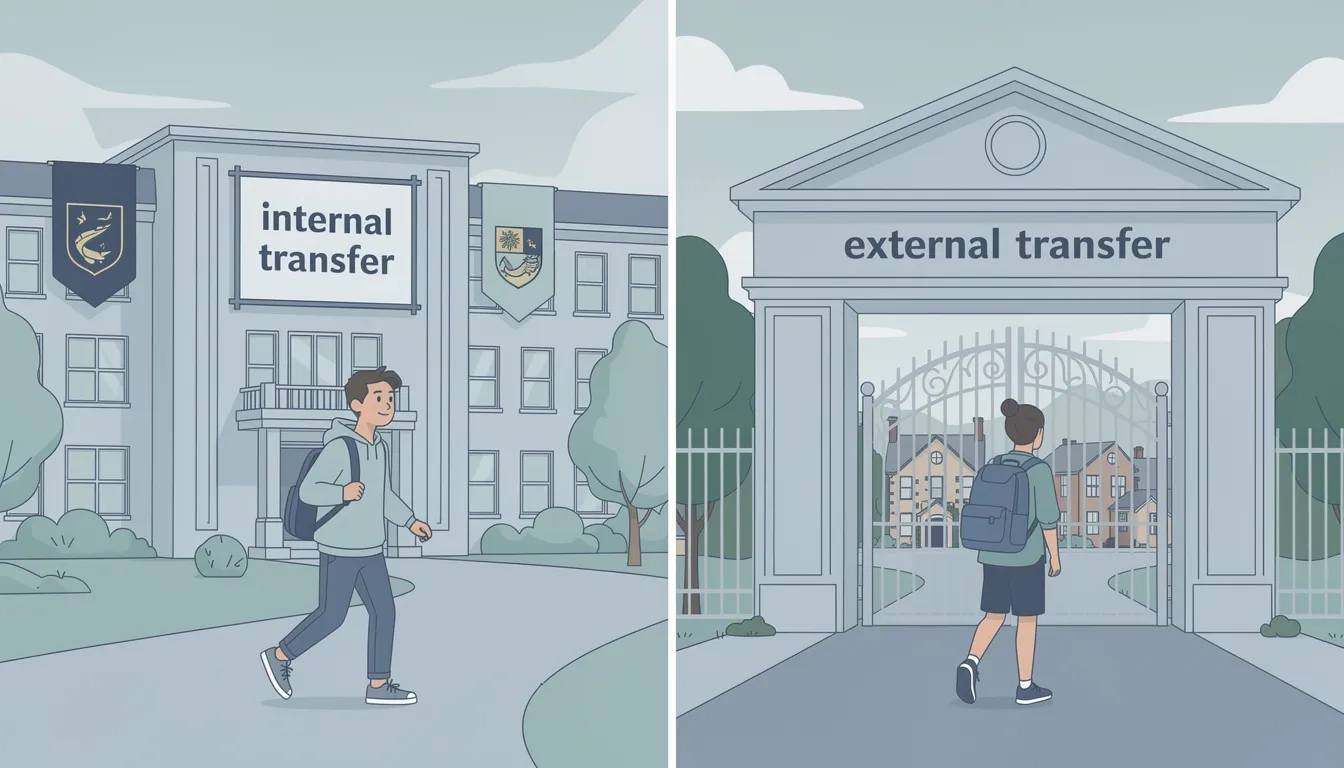
The most jarring number in college admissions right now isn't Harvard's 3.4% freshman rate. It's UT Austin's external transfer acceptance rate into Computer Science: 0.58%. Six students admitted out of 1,037 applicants in Fall 2024. And here's the part that makes it stranger — internal transfers from within UT's own campus filled more than half the admitted spots in that same program.
That gap tells you almost everything about how competitive program transfers actually work. The rules are different depending on which game you're playing, and most applicants don't figure that out until they're already mid-application.
The Internal vs. External Divide Nobody Talks About
Most transfer guides treat "competitive programs" as one category. They're not. There are two distinct games with different odds, different strategies, and different definitions of "qualified."
Internal transfers move between programs within the same university. They face high bars, but home-court advantages come with that: pre-sorted credit equivalencies, access to department advisors before applying, and existing relationships with faculty in the target program. At UT Austin's McCombs School of Business, internal transfer acceptance rates run several times higher than the sub-10% rate for outside Texas residents.
External transfers arrive from a different institution entirely. They're proving themselves to a school that has no prior relationship with them, no baseline trust, and often fewer open seats. Before doing anything else, get clear on which situation you're in.
Acceptance Rates Tell Half the Story
The headline comparisons are genuinely encouraging. UCLA's transfer acceptance rate sits around 22.7%, versus 9% for freshmen. UC Berkeley admits transfers at 25.5%, compared to under 12% for first-year applicants. Boston University's Fall 2024 transfer rate was 34.6%, while its freshman rate was just 11%.
Those numbers make transfer admissions look like an easier path. Sometimes it is. But those are school-wide rates.
Engineering, nursing, CS, and business programs at flagship universities function more like separate admissions offices — with their own GPA floors, prerequisite lists, and acceptance rates that often bear no resemblance to the school's headline figure.
The school-level number tells you almost nothing about your odds in the Electrical Engineering department. You need program-level data. Call the department. Email the undergraduate advisor. That information is usually available if you ask directly, and it's worth the 15-minute phone call.
GPA Is the Foundation (But Which GPA?)
Every competitive program has a GPA floor, and most of them care more about some grades than others. This distinction trips up a lot of applicants.
Engineering and CS programs frequently calculate a separate technical GPA from math and science courses alone. At the University of Minnesota's College of Science and Engineering, successful applicants typically hold a 3.2 or above in technical coursework, independent of their overall average. At UT Austin's Cockrell Engineering School, the most competitive majors (Electrical and Biomedical) effectively require a 4.0 in STEM courses — not just a solid cumulative GPA.
Here's how competitive GPA ranges break down across program types at selective schools:
| Program Type | Typical Minimum GPA | Competitive GPA |
|---|---|---|
| Computer Science (flagship) | 3.5 | 3.9–4.0 |
| Electrical/Biomedical Engineering | 3.7 | 4.0 |
| Civil/Petroleum Engineering | 3.3 | 3.5+ |
| Business (top programs) | 3.5 | 3.9 |
| Nursing | 3.0 | 3.5+ |
| General Sciences | 2.8 | 3.2+ |
"Minimum" means your application gets read. "Competitive" means you actually get in. The gap between those two numbers is usually wider than applicants expect.
One non-obvious point: a B in Calculus II can eliminate you faster than a B+ in English. If your target program calculates a technical GPA separately, your strategy for remaining semesters should reflect exactly that.
Articulation Agreements: The Hidden Fast Lane
This is the piece that most community college and first-generation transfer students don't find out about until it's too late.
Articulation agreements are formal contracts between two-year and four-year institutions. They spell out which courses transfer as which equivalencies and, in some cases, guarantee admission to competitive programs when specific criteria are met. The UC system's Transfer Admission Guarantee (TAG) program is the most widely known example: students who complete designated coursework at a California community college with a 3.4+ GPA (3.5 for engineering) can lock in guaranteed admission before they finish their associate degree.
Even Cornell's College of Agriculture and Life Sciences maintains formal articulation agreements with several two-year programs, meaning community college students have a structured path into an Ivy. The practical upside is enormous. Instead of gambling on a 22% acceptance rate, you're relying on a contract.
The tradeoff is precision. You have to follow the transfer pathway exactly: the right courses, the right grades, and often the right timing (many TAG deadlines fall in September of the year before transfer). An hour on ASSIST.org if you're in California, or your state's equivalent articulation database, can change your transfer trajectory more than a semester of extra coursework.
The Prerequisite Timing Problem
Most competitive programs require specific prerequisites to be completed, or at minimum in-progress, by a hard deadline. Miss that window and your application gets deferred or rejected regardless of GPA.
At UT Austin, both McCombs Business and Cockrell Engineering require 24 completed or in-progress hours plus specific prerequisites by March 1. At NC State, studio-based programs in Design and Architecture have a November 1 application deadline, meaning portfolios and coursework need to be substantially complete in the fall.
The standard mistake is applying a semester early without the required prerequisites rather than waiting one more term to finish them. Taking an extra semester to complete Calculus II and Physics I with a strong grade is almost always the right call over submitting an application that will be reviewed as incomplete.
Prerequisite requirements by program type:
- Engineering: Calculus I and II, Physics I with lab (required at most schools)
- Computer Science: Calculus, discrete math, at least one programming course with demonstrated projects
- Business: Micro and macroeconomics, calculus, often statistics
- Nursing: Biology, Chemistry, Anatomy and Physiology, sometimes Microbiology
Check whether "in-progress" courses count toward your application. Many programs allow it. That distinction can mean the difference between applying this cycle or sitting out an entire year.
The Transfer Essay Is Not a Personal Statement
This is the elephant in the room in transfer admissions coaching. Many applicants pull out their college application essay, update a few sentences, and submit it. Admissions readers spot this quickly.
The transfer essay has one job: explain why you've outgrown your current environment and why this specific program is the next step in a coherent academic trajectory. It's forward-facing. The reader isn't asking "who are you?" They're asking "why here, why now, and why will you succeed?"
The most common failure mode is spending 400 words explaining your current school's shortcomings, then cramming a half-formed vision into the last 150. Flip that ratio. The backward-looking section should be tight and neutral at worst. The forward-looking section should name specific faculty, research labs, courses, or clinical rotations at the target program.
Spark Admissions' transfer essay analysis notes that essays for competitive programs typically land in the 550–650 word range. Under 500 words often reads as underdeveloped; over 700 starts to feel like the applicant is justifying rather than declaring.
One more thing: don't complain about professors. Not even obliquely. Admissions committees at the programs you're targeting often work alongside those same faculties.
Building the Case Beyond GPA
Once your GPA clears the competitive threshold, the differentiating factors shift. Letters of recommendation, research experience, and demonstrated engagement with the specific field start carrying real weight.
Professor recommendations outrank peer or workplace references in transfer admissions because they speak directly to your capacity to function as a college-level scholar. A well-written letter from a professor who supervised your independent research project is worth considerably more than a strong reference from a manager who likes your attitude.
For STEM programs specifically, UT Austin's transfer guidance for external CS applicants explicitly lists coding experience through professional roles and familiarity with multiple programming languages as differentiators, not suggestions. The bar is genuinely that specific.
A few ways to build your case in the months before applying:
- Join a research lab or faculty project at your current school, even in a supporting capacity
- Build something with a public record: a documented GitHub repo, a portfolio site, a published analysis
- Use office hours specifically to build relationships with faculty who might write your letter
- Find extracurricular organizations directly tied to your target field (finance club for business, an ACM chapter for CS)
The belief that a 3.9 GPA alone carries you into a top competitive program is a comfortable myth. The students getting in also have the work to show — and they can point to it.
Bottom Line
- Figure out whether you're playing the internal or external transfer game before anything else. The strategies, the odds, and the documentation requirements are genuinely different.
- GPA minimums are not your target. Find the program-specific competitive range, and understand whether a technical GPA is being calculated separately from your cumulative average.
- If you're at a community college, check articulation agreements before registering for courses. A TAG program or formal pathway can replace a competitive gamble with a contract.
- Complete prerequisites on schedule. An extra semester of preparation almost always beats an early application that arrives incomplete.
- Write the transfer essay as a forward-facing case, not a memoir. Name specific programs, faculty, and opportunities at the target school. That specificity is what moves applications from the maybe pile to the yes pile.
Frequently Asked Questions
Can I transfer into a competitive program with a 3.0 GPA?
It depends on the program. Nursing programs at many state schools accept transfers with a 3.0 cumulative GPA, and some engineering programs list 3.0 as a minimum. For CS or business at flagship universities, a 3.0 rarely clears the competitive threshold — at UT Austin's McCombs, for example, the competitive range starts around 3.9. Research the program-specific data rather than the school-wide minimum.
What is the difference between a minimum GPA and a competitive GPA for transfers?
A minimum GPA means your application won't be automatically rejected. A competitive GPA puts you in the range where admitted students actually land. For high-demand programs like UT Austin McCombs, applicants with a 4.0 are regularly denied because GPA alone doesn't determine admission — experience, essays, and recommendations all factor in. Treat the listed minimum as a floor, not a target.
Is it a myth that community college students can get into top programs?
Yes, it's a myth that they can't. The UC system's TAG program guarantees admission to UC campuses for California community college students who meet specific GPA and coursework requirements — and even Cornell maintains formal articulation agreements with two-year institutions. The path exists, but it requires following the agreement precisely and hitting deadlines that often fall earlier than most applicants realize.
Do community college credits transfer to competitive four-year programs?
Yes, but how they transfer depends entirely on the receiving institution's policies and whether a formal articulation agreement exists. Without one, individual courses may be evaluated case-by-case, and some competitive programs only accept credits as free electives rather than substitutes for required major prerequisites. Verify transfer equivalencies with the specific department before registering for any course you're counting on.
How important is the transfer essay for competitive programs?
Very. Once GPA clears the threshold, dozens of applicants often look nearly identical on paper. The essay and letters of recommendation become the deciding factors. Vague statements like "I want to challenge myself academically" are among the most common failure points in transfer essays, according to Spark Admissions' analysis of successful applications. Specific, program-grounded writing — naming actual courses, faculty, and research opportunities — is what differentiates competitive applicants.
Should I apply to my target competitive program right away, or wait a semester?
Wait if you're missing prerequisites. Applying to an engineering or CS program without Calculus II completed (or in-progress) almost always results in a deferral or rejection, regardless of your other qualifications. Programs are evaluating whether you're ready to hit the ground running on day one. A semester spent finishing required coursework with strong grades is almost always a better use of time than submitting early.
Sources
- Transfer Acceptance Rates at Four-Year Schools | BestColleges
- External Transfer to UT Austin CS, McCombs Business, Cockrell Engineering | Tex Admissions
- Recommendations for Competitive Applicants | NC State Transfer Student Resources
- Guide to Articulation Agreements | IvyWise
- Transfer Admission Rates: Your Chances of Acceptance | IvyWise
- Transfer Essay Examples & Strategy | Spark Admissions