By Colleges4Us Editorial Team · October 26, 2026

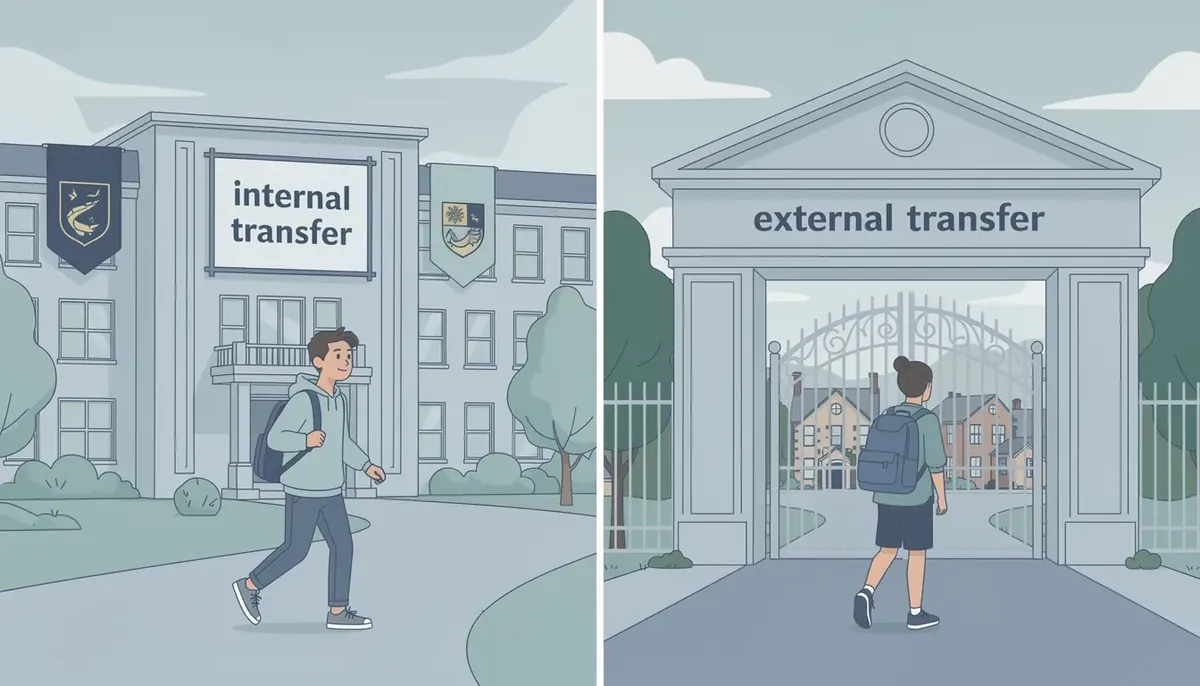
Every fall, a fresh wave of community college students shows up with a plan: two years here, two years there, one bachelor's degree, half the price. It's a good plan. It's also one that goes sideways for most people who try it — not because they weren't smart or capable enough, but because nobody walked them through the mechanics of how transfer actually works.
Here's the number that should be on every community college orientation slide and somehow isn't: only 31.6% of first-time students who started at a two-year college in fall 2017 had transferred to a four-year institution within six years, and just 18% of the fall 2018 cohort earned a bachelor's degree in that same window. That's not a knock on community college students — it's a sign that the transfer pipeline itself is leaky, full of avoidable friction that has nothing to do with ability.
The good news buried in that same research: once students do transfer, the odds improve dramatically. Among students who transferred from a community college, 65.8% earned a bachelor's degree within six years of transferring, and 81.8% re-enrolled at their new four-year school the following year. Transfer isn't the hard part in some abstract sense — it's the part where most of the damage is actually preventable.
The Misconception That Wrecks Transfer Plans
"I took the classes, I passed them, so obviously they'll count." That single assumption is responsible for more delayed graduations and wasted tuition dollars than any other mistake in the transfer process.
Community college credits do not automatically transfer as satisfying specific requirements at a university — they transfer as credits earned, which is a different thing entirely. A university can accept your 60 transfer units and still tell you that only 40 of them count toward your intended major, because the other 20 were electives, remedial coursework, or classes that don't have an equivalent in the receiving school's catalog.
This isn't a rare edge case. A U.S. Government Accountability Office analysis of transfer students found they lost an estimated average of 43% of their credits across all transfer pathways. The community-college-to-public-university path is actually the best-performing route in that data — students moving from a public two-year college to a public four-year college lost an estimated 22% of their credits, the lowest loss rate of any pathway studied. Compare that to students transferring between two different community colleges, who lost an average of 69% of their credits. So the two-year-to-university path is relatively efficient — but "relatively efficient" still means roughly a fifth of your work can evaporate on paper if you don't plan around it.
The fix isn't hoping for the best. It's using the tools built specifically to prevent this — articulation agreements — before you register for a single class, not after.
How Transfer Pathways Actually Work
Not all transfer arrangements are the same animal, and mixing them up is where a lot of planning goes wrong. Here's how the three main types compare:
| Pathway Type | What It Guarantees | Best For | Watch Out For |
|---|---|---|---|
| Articulation Agreements (e.g., ASSIST.org for California) | Course-by-course equivalency — this community college class = that university class | Students who know their major and target school early | Agreements are specific to a course-pair; a slightly different class at a different campus may not be covered |
| Guaranteed Admission Programs (TAG, ADT/AA-T/AS-T, MAPP-style pathways) | Guaranteed admission (sometimes to a system, not a specific campus/major) if minimum GPA and course requirements are met | Students who want certainty and are willing to follow a fixed curriculum | Guarantees junior standing, not always your first-choice campus or impacted major |
| Case-by-Case Credit Evaluation | Individual review by a registrar or department once you've already been admitted | Students transferring without an articulation agreement in place, or transferring out-of-state | Slowest, least predictable, most likely to result in credit loss |
California's ASSIST system is the clearest real-world example of the first category: it's the official, state-designated repository of articulation agreements between California Community Colleges and the UC and CSU systems, letting students look up exactly which courses at their specific community college satisfy specific requirements at a specific university campus.
The second category — guaranteed admission — has real teeth but real limits. Six UC campuses (Davis, Irvine, Merced, Riverside, Santa Barbara, and Santa Cruz) participate in the Transfer Admission Guarantee program; UCLA, Berkeley, and UC San Diego do not. Meanwhile, California's Associate Degree for Transfer (the AA-T or AS-T, created under the Student Transfer Achievement Reform Act) guarantees priority admission somewhere in the CSU system once a student completes a 60-unit degree with at least a 2.0 GPA — but it does not guarantee a specific campus or a specific impacted major. Similar structures exist elsewhere: Arizona State's Maricopa to ASU Pathways Program (MAPP) lays out fixed curriculum plans for Maricopa Community College students, and several Virginia four-year schools, including Virginia Tech, the University of Virginia, and William & Mary, maintain their own guaranteed admission agreements with the state's community colleges.
Transfer Shock Is Real — Here's How to Blunt It
Even when the credits transfer cleanly, something else tends to happen: grades dip. Researchers have been documenting this since 1965, when John R. Hills first named it "transfer shock" — a temporary GPA drop in the first one to two semesters after moving from a community college to a university. It's not a myth or a stereotype; recent analysis of more than 25,000 transfer students at a large flagship university found an average first-term GPA drop of about 0.30 points, and roughly 17% of students showed a decline meaningfully beyond normal semester-to-semester variation.
This matters more than it sounds like it should. That same research found students whose GPA dropped by 0.5 points after transferring had a 9% lower probability of ever completing their bachelor's degree compared to students whose GPA held steady. In other words, the shock itself isn't just uncomfortable — it's a real risk factor for not finishing.
Two things reliably reduce it:
- Transferring with more credits and academic momentum. Students who transfer with upper-division status — generally an associate degree or 60+ completed credits — experience less severe transfer shock than students who transfer early with fewer credits.
- Prior dual enrollment. Students who had dual enrollment coursework before community college transferred to a four-year school at a rate of 45.4%, compared to 31.6% for students without that experience — a strong signal that early exposure to college-level rigor smooths the whole pathway.
- Building social connections fast. Students who developed peer relationships and a sense of belonging in their first term at the new institution were more likely to perform better academically and avoid the worst of the GPA dip.
None of that requires luck. It requires showing up to the new campus already looking for a study group, a club, or an advisor relationship in week one — not week ten.
A Step-by-Step Transfer Planning Timeline
Transfer planning works best as a multi-semester project, not a single application season. A reasonable timeline looks like this:
- First semester at community college: Meet with a transfer counselor immediately, even if the destination university feels far off. Declare an intended major, not just an intended school.
- By end of first year: Identify 2-3 target universities and pull up their articulation agreements (via ASSIST.org for California schools, or the equivalent transfer-credit database for your state) to see exactly which of your classes will count.
- Second year, first semester: Decide whether a guaranteed-admission pathway (TAG, ADT, or an equivalent program) fits your goals. If so, map your remaining courses to that program's exact requirements — these are usually rigid.
- Second year, mid-year: Request an unofficial transcript review from your target school's transfer admissions office. Don't wait for the official application to find out something didn't articulate.
- Second year, application season: Apply through the guaranteed pathway if eligible, or as a standard transfer applicant if not, submitting to multiple schools if your credits didn't fit neatly into one guarantee.
- After admission, before enrolling: Get an official transfer credit evaluation in writing. Compare it against what you expected based on the articulation agreement, and appeal any discrepancies immediately — evaluations are corrected far more easily before your first semester than after.
- First semester at the university: Front-load connection-building — office hours, a study group, one club — to counter transfer shock while the coursework ramps up.
Getting Your Credits Evaluated Without Getting Burned
A few practical habits protect you when it's time for the actual credit evaluation:
- Keep every syllabus. If a course doesn't have an exact articulation match, a syllabus showing learning outcomes is often what convinces a department to grant equivalency anyway.
- Get everything in writing. A verbal assurance from an advisor that "this should transfer" is not the same as a credit evaluation letter. Only the letter protects you if a decision changes later.
- Ask about the difference between "transfers" and "counts." A university admissions office might accept a credit as general elective units while the specific department you're applying to doesn't count it toward the major — ask both questions separately.
- Don't assume the guarantee covers everything. A TAG or ADT guarantee is about admission, not about which specific courses satisfy your major requirements once you arrive — those are usually evaluated separately.
Bottom Line
- Use an articulation agreement system like ASSIST.org before you register for classes, not after — course-by-course equivalency is set in advance and dramatically cuts your risk of credit loss.
- Understand which type of transfer pathway you're using — an articulation agreement, a guaranteed admission program (TAG, ADT), or case-by-case evaluation each carry different guarantees and different risks.
- Aim to transfer with an associate degree or 60+ credits — students with more academic momentum experience measurably less transfer shock.
- Get every credit decision in writing before you commit to enrolling, and appeal discrepancies immediately.
- Build social connections in your first term at the new school — it's one of the few transfer-shock mitigators fully within your control.
- Start the planning process in your first year, not your last semester — the timeline for articulation research and guaranteed-admission requirements needs real runway.
Frequently Asked Questions
Do all community college credits automatically transfer to a university? No. Credits transfer as units earned, but whether they satisfy a specific requirement depends on articulation agreements or a case-by-case evaluation. Public two-year to public four-year transfers see the least credit loss of any transfer pathway, but an estimated 22% loss is still common even in that best-case scenario.
What's the difference between an articulation agreement and a guaranteed admission program? An articulation agreement (like those on ASSIST.org) matches individual courses between two specific schools. A guaranteed admission program, like a TAG or an Associate Degree for Transfer, guarantees you'll be admitted somewhere in a university system if you meet GPA and coursework requirements — but not necessarily to your first-choice campus or major.
Is "transfer shock" something that happens to most students? It's common but not universal — research suggests around 17% of transfer students see a GPA drop beyond normal fluctuation, with an average first-term decline of roughly 0.30 points. Students who transfer with more credits, prior dual enrollment experience, or strong early social connections tend to experience it less severely.
Does an associate degree guarantee admission to a four-year university? Sometimes, depending on the program. California's Associate Degree for Transfer (AA-T/AS-T) guarantees priority admission somewhere in the CSU system with a minimum 2.0 GPA, but doesn't guarantee a specific campus or impacted major. Other states and systems have their own versions with different terms.
How early should I start planning my transfer? As early as your first semester at community college. Declaring an intended major and target schools early lets you check articulation agreements before you take classes that might not count — waiting until your last semester significantly raises the odds of credit loss.
What should I do if a class I took doesn't appear in my transfer credit evaluation? Request the evaluation in writing, then appeal with supporting documentation — a syllabus is often enough to show a course's content matches a required class even without a formal articulation agreement. Do this before enrolling, since evaluations are far easier to correct at that stage.
Sources
- Fewer than One in Five Students Who Began at Community Colleges Earned a Bachelor's Degree Within Six Years — National Student Clearinghouse
- Higher Education: Students Need More Information to Help Reduce Challenges in Transferring College Credits — U.S. GAO
- CCC Associate Degree for Transfer — California State University
- Guaranteed Admissions — UC Irvine Office of Undergraduate Admissions