Research University vs Teaching University: Which One Is Actually Right for You?
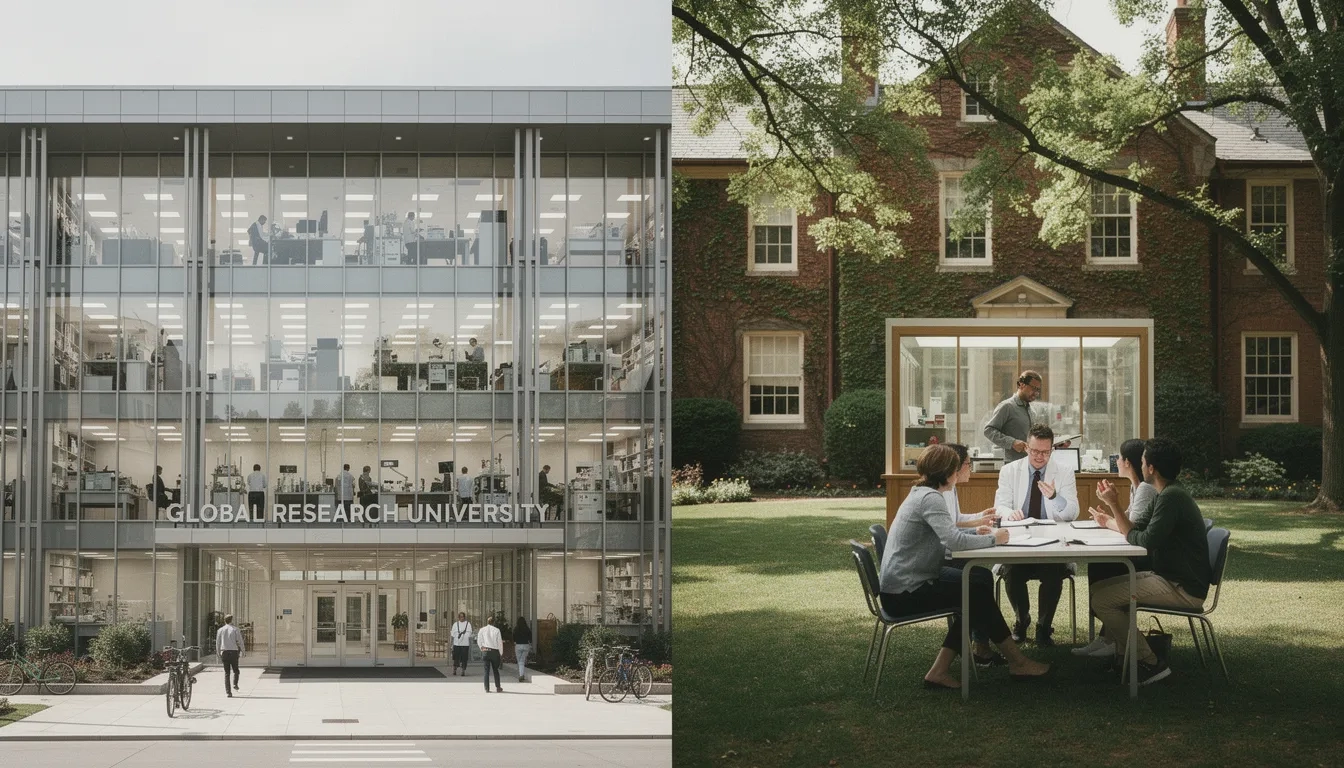
Here's a question most 17-year-olds get wrong: they pick a college based on name recognition and assume the teaching is roughly equivalent everywhere. It isn't. A freshman at MIT and a freshman at Williams College are having fundamentally different educational experiences — even if both end up in the same PhD program five years later. Understanding that split before you apply might be the single most useful thing you do.
Two Different Missions Under One Label
The word "university" covers an enormous range. Some schools are primarily knowledge-production operations. Their core business is generating peer-reviewed research, training doctoral students, and winning federal grants. Others exist mainly to teach undergraduates well.
Neither mission is better by default. But they create very different daily realities.
The clearest dividing line is what a school asks its faculty to do. At a research-heavy institution, a professor's tenure case hinges on publications, grant dollars, and doctoral students supervised. Teaching is expected, but it's rarely what determines whether someone gets promoted. At a teaching-focused school, the calculus flips: how well you develop undergraduates is the whole point.
What the Carnegie Classification Actually Tells You
If you want a quick read on where a school falls on this spectrum, look up its Carnegie Classification. The American Council on Education overhauled the system in 2025 with a redesigned methodology, and the result is cleaner than what came before.
R1 status now requires two hard thresholds: at least $50 million in annual research spending and at least 70 research doctorates awarded per year. There are 187 R1 institutions in the U.S. as of 2025, up from 146 in 2021. Those 41 new entrants are schools that crossed the threshold as research spending grew.
As Timothy Knowles, president of the Carnegie Foundation, put it: "The arms race to become an R-1 institution created a whole set of perverse incentives." Schools were adding doctoral programs they didn't need, reshaping their identities around a vague relative ranking rather than their actual strengths.
The 2025 system also introduced a new RCU category (Research Colleges and Universities) for 216 smaller schools that spend at least $2.5 million on research but don't prioritize doctoral production. That's a meaningful acknowledgment that research happens in many forms across many institution types.
What Your Day-to-Day Actually Looks Like
This is where the rubber meets the road. At large public R1 schools, introductory courses routinely enroll 200 to 400 students in a lecture hall. You'll attend discussion sections of 20 to 25 people led by a graduate teaching assistant, not by the professor whose name is on the syllabus.
That structure isn't negligence. It's a predictable consequence of the mission. A tenured professor at a flagship state university might teach two courses a semester while running a lab with six doctoral students, writing grant proposals, and peer-reviewing manuscripts for journals.
At a teaching-focused school, the same professor typically teaches four courses per semester. Their professional identity is bound up in the classroom. You'll know their name; they'll likely know yours.
Here's how the two types compare across the factors that actually affect your experience:
| Factor | R1 Research University | Teaching/Liberal Arts College |
|---|---|---|
| Student-faculty ratio | ~19:1 (public), ~12:1 (private) | ~8:1 average |
| Intro course size | 100–400 students | 15–30 students |
| Who leads small sections | Graduate TAs | Professors |
| Faculty tenure criteria | Research and grants dominant | Teaching and scholarship |
| Graduate programs | Full range (PhD, MD, JD, MBA) | Mostly bachelor's; some master's |
| Research labs on campus | Extensive and well-funded | Fewer, but accessible to undergrads |
Williams College (to pick a well-known example) sits at a 6:1 student-faculty ratio. The University of Michigan sits around 15:1. That gap isn't just a number — it shapes how often you talk to a professor, how quickly you get feedback on a draft, and how personal a recommendation letter can realistically be.
The Research Opportunity Question
Here's the counterintuitive part. You might assume that a research university automatically gives undergrads the best shot at doing real research. Sometimes that's true. But the reality is messier.
At R1 universities, labs are active and well-resourced. The opportunities exist. But so does the competition. A sophomore hoping to join a prominent lab at UC Berkeley or the University of Michigan is competing against hundreds of other motivated students, plus graduate students and postdocs who are full-time researchers. Landing a meaningful role takes persistence, cold emails, and sometimes just luck.
At primarily undergraduate institutions (PUIs), research opportunities are fewer in raw number, but undergraduates are often the only researchers available. A chemistry professor at Grinnell College running an active project will hand you a pipette and trust you with it. According to MOST Policy Initiative's analysis, PUI students show better retention in research internships than their counterparts at large R1 schools — likely because they've had more direct, substantive lab experience before applying.
The CBE-Life Sciences Education journal found that undergraduate research experiences significantly predict both persistence in science and intention to pursue graduate school. What mattered wasn't the prestige of the institution, but the depth of the experience itself.
Grad School and Career Outcomes
If a PhD is the goal, this question matters more than almost any other college decision. Admissions committees at top doctoral programs want evidence that you can sit with a problem, run experiments, tolerate not knowing the answer, and think rigorously about data.
A strong R1 school can give you that exposure faster, if you're proactive. Working in a lab sophomore year and co-authoring a paper by senior year are realistic outcomes at schools like Purdue or Michigan State, for students who seek out those opportunities. The NSF's Research Experiences for Undergraduates program also exists precisely to help students at all institution types access this kind of work, regardless of where they're enrolled.
The flip side: research universities show lower four-year graduation rates and higher dropout rates than teaching-focused schools, and those outcomes are worse for underrepresented students. The MOST Policy Initiative analysis flagged this directly, noting that the scale and relative impersonality of large research schools disproportionately affects first-generation and minority undergraduates. That's not a footnote.
For students heading into industry rather than academia, large R1 schools often have bigger alumni networks and host on-campus recruiting from major employers. A student at the University of Texas Austin is more likely to find a Google or McKinsey recruiter on campus than a student at a small school in rural Ohio. That network advantage is real, even if it shows up nowhere in the U.S. News rankings.
How to Actually Choose
The choice between a research university and a teaching-focused school shouldn't be about prestige chasing. It should be about matching your learning style and goals to the environment that rewards them.
Choose a research university if:
- You are self-directed and comfortable seeking out opportunities rather than waiting for them
- You want a PhD and plan to pursue undergraduate research aggressively from your first year
- You're studying engineering, computer science, or pre-med, where graduate-level resources and equipment matter from day one
- You want access to large alumni networks and on-campus recruiting infrastructure
Choose a teaching-focused or liberal arts college if:
- You learn better in small groups with direct faculty contact
- You're still figuring out your direction and want genuine intellectual breadth before specializing
- You want recommendation letters from professors who watched you think for a whole semester, not someone who barely remembers your face
- You value mentorship from faculty whose job is specifically to develop undergraduates, not to publish the next paper
One practical point that most guides skip over: recommendation letters are currency. Getting a compelling letter from a professor at a 400-person lecture course is genuinely difficult — they won't know your work unless you went well out of your way to be visible outside class. At a small college, the professor who taught your 18-person seminar has something real to say about you.
The False Dichotomy Worth Calling Out
Here's my actual take: the research vs. teaching framing is partially a false choice, at least at the top of the college market. Amherst, Williams, and Swarthmore expect their faculty to do publishable scholarly work. Harvard and Princeton have some of the strongest undergraduate teaching anywhere — small seminars, intensive advising, direct faculty contact.
The real divide shows up in the middle tiers. A large state flagship with 45,000 students and a regional teaching university with 8,000 students are genuinely different places to learn. That's where Carnegie tier functions as a useful proxy for classroom culture, and where your choice will most visibly affect your day-to-day.
What separates good institutions of either type isn't the research-to-teaching ratio in the abstract. It's whether the faculty are intellectually alive in their fields — and whether the institution's structure actually gives you access to them. A professor who just returned from fieldwork or published something that challenged their field's consensus will teach with a kind of energy that's hard to manufacture. You want that, regardless of where you enroll.
Bottom Line
- If you want a PhD and can navigate a large campus independently, a strong R1 school with active labs gives you a head start — but you have to go find the opportunities yourself.
- If you want close mentorship, broad intellectual development, or recommendation letters from professors who actually know your work, a teaching-focused institution often delivers better undergraduate outcomes.
- Research experience matters for graduate admissions no matter where you do it. REU programs, summer internships, and independent study count — the lab doesn't have to be at an R1 school.
- Don't treat Carnegie R1 status as a teaching quality signal. It measures research volume, not how well undergrads are taught. Those are different things.
- The most useful question to ask on any campus visit: "Who actually teaches the intro-level courses?" If the honest answer is graduate students, you know what you're walking into.
Frequently Asked Questions
Is a research university better for getting into graduate school?
Not automatically. PhD programs want proof that you can do research, not just that you attended a school with labs. Students from liberal arts colleges who worked closely with faculty on publishable projects are frequently stronger applicants than students from R1 schools who sat in 300-person lectures and never found a lab position. Access matters; the institutional label matters less.
What does R1 actually mean when a college lists it on their website?
R1 is the highest Carnegie Classification research designation. As of 2025, 187 U.S. institutions hold it, all spending at least $50 million annually on research and awarding at least 70 research doctorates per year. It's a measure of research output and spending volume. It says nothing about undergraduate class sizes, teaching quality, or how much time faculty spend with students.
Do professors at research universities care about teaching?
Most do personally, but their institutional incentives push toward research. Tenure and promotion at R1 schools weight publications and grant funding more than teaching evaluations. That doesn't make them bad teachers — it means their time is genuinely divided, and undergrad access is often more limited than the course catalog suggests.
Isn't a big-name research university always worth it for the brand?
The name carries real value in specific industries and cities, but it's not universal. For many careers outside finance, consulting, and top-tier tech, where you went matters far less than what you did while you were there. A strong GPA with meaningful research experience from a solid regional school will open more doors than a mediocre record from a prestigious one.
Are teaching universities less academically rigorous?
No, and this is the most persistent myth worth squashing. Williams, Pomona, Bowdoin, and similar colleges consistently send students to elite doctoral programs at higher per-capita rates than many flagship R1 schools. Academic rigor comes from depth of engagement and quality of instruction, not the size of the research budget.
Sources
- Research vs. Teaching Universities — MOST Policy Initiative
- Carnegie Classifications Release 2025 Research Activity Designations — ACE
- Ending the Research 1 "Arms Race" — Inside Higher Ed
- Research University vs Teaching University — Academic Influence
- 6 Key Differences: Liberal Arts Colleges vs Research Universities — Galin Education
- Undergraduate Research Experiences Support Science Career Decisions — CBE Life Sciences Education