Religious vs. Secular Colleges: What to Actually Expect
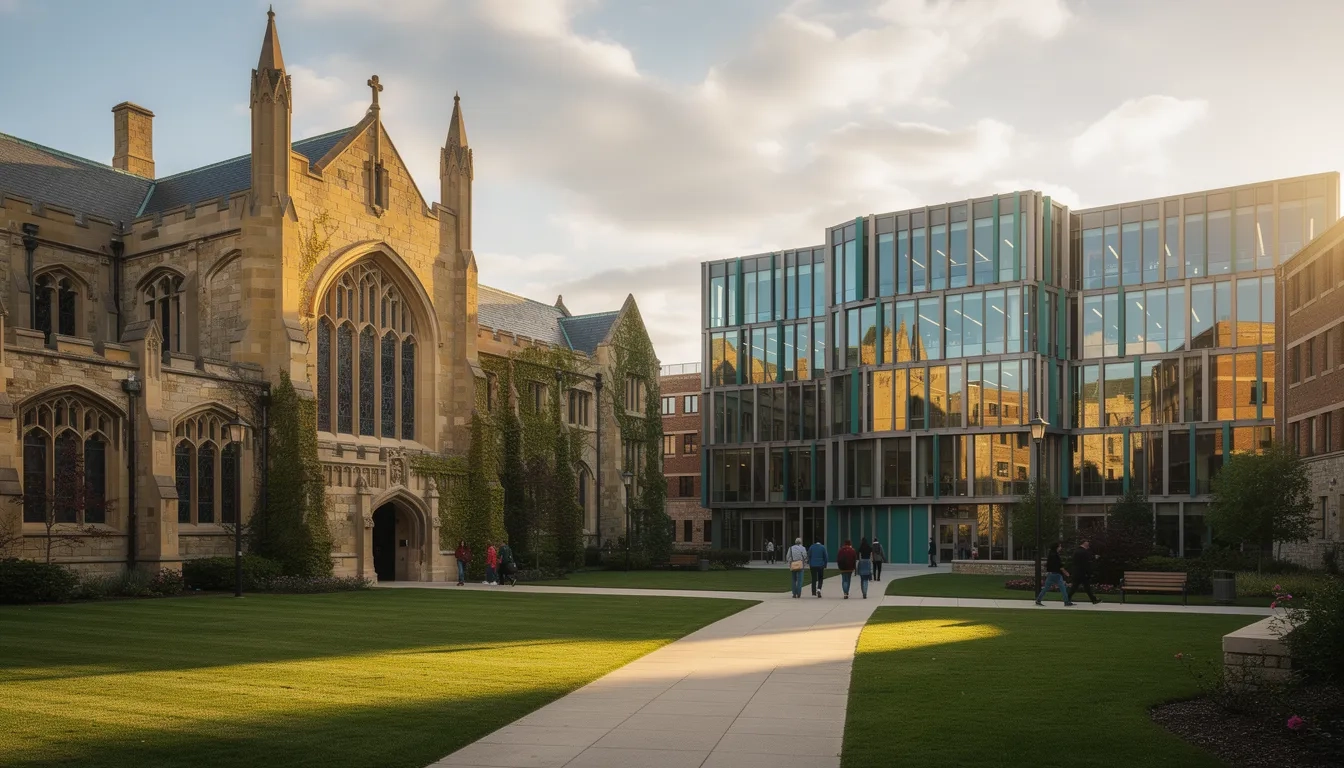
Franciscan University of Steubenville grew its enrollment 46% over the past decade. Meanwhile, secular private colleges lost 18% of their students between 2010 and 2021, according to a Christian Scholar's Review analysis of federal enrollment data. That gap is not a rounding error, and it's rewriting what "picking a college" even means for a lot of families right now.
If you're choosing between a religious and a secular school, you're not just picking a vibe. You're picking a rulebook, a worldview default, and in some cases, a legal framework that governs how the school can treat you. Here's what actually changes.
Mission, Curriculum, and What Gets Taught
A secular college's mission statement usually says something about "critical inquiry" or "preparing global citizens." A religious college's mission statement says something about forming souls, and it means it. That difference trickles into the classroom in ways that surprise a lot of incoming freshmen.
Required theology or Bible coursework is the biggest curricular divergence. Most Council for Christian Colleges and Universities (CCCU) member schools require two to four courses in biblical studies or theology regardless of your major — a biology student at Wheaton College takes the same core faith requirement as a philosophy student. Catholic institutions like Franciscan University or Belmont Abbey College similarly require theology and philosophy credits tied to Church teaching.
Secular schools don't do this. A state university might offer a comparative religion elective, but nobody's requiring it of the engineering majors.
The bigger, quieter difference is interpretive framing:
- Biology and psychology at religious schools often get taught alongside a faith-compatible lens on origins or human nature, sometimes explicitly (young-earth creationism at some evangelical schools), sometimes just through faculty who integrate faith commentary into lecture.
- Literature and history courses at religious schools may foreground a Western, faith-influenced canon more heavily than a secular peer institution would.
- Business and pre-law programs are the most similar across both types — accreditation standards flatten most of the difference here.
None of this means religious college science is bad science. Franciscan, Baylor, and Notre Dame produce plenty of researchers who publish in the same journals as their secular counterparts. But if your intellectual comfort zone requires an instructor never framing a topic through a specific theological lens, that's worth checking program by program, not campus by campus.
Academic Freedom Works Differently, Not Less
Here's the part people get wrong most often: they assume "religious college" automatically means "less academic freedom." It's more accurate to say the freedom operates inside a different boundary.
At a secular university, academic freedom is bounded mostly by professional norms and institutional neutrality — a professor can argue almost anything as long as it's defensible scholarship. At a religious institution, many faculty sign a statement of faith as a condition of employment, and that statement functions as an outer boundary on what positions they can advocate in class.
Some scholars argue that faculty statements-of-faith requirements gravely limit inquiry. Others counter that every institution operates within some worldview commitment — a secular university just doesn't name its commitments as explicitly.
That second point is worth sitting with. A secular sociology department isn't neutral either; it operates within a set of disciplinary assumptions that go mostly unstated. Religious schools just put their assumptions in writing, which makes them easier to criticize and, honestly, easier to evaluate before you enroll.
Practical takeaway: if you're picking a major where the theological boundary actually matters — theology itself, philosophy, gender studies, evolutionary biology — read the faculty handbook's academic freedom clause before you apply, not after your first controversial class discussion.
Admissions: The Statement of Faith Question
Contrary to what a lot of applicants assume, most faith-based colleges do not require students to share the school's religion. A holistic Christian college application typically layers standard academic materials — transcripts, test scores, essays — with something extra: a personal statement on your faith journey, a pastor's reference letter, or a short interview about your spiritual background.
Here's the nuance that trips people up:
- You usually don't need to be a believer to attend. Plenty of CCCU schools admit students of other faiths or no faith at all.
- You usually do need to follow the rules regardless. Chapel attendance requirements, mandatory Bible courses, and behavioral covenants typically apply to every student, believer or not.
- A smaller subset of schools — think Bob Jones University or Liberty University's residential program — do require a signed faith commitment or lifestyle covenant as a condition of enrollment, not just employment.
So the real question to ask on a campus visit isn't "do I have to be Christian to go here?" It's "what am I committing to sign, and what happens if I break it?" Get the actual student handbook. Read the conduct section, not the mission page.
Campus Life: Rules, Community, and the Trade-Off Nobody Mentions
This is where the two experiences diverge hardest, and it's genuinely a trade-off rather than a clear win for either side.
Religious campuses tend to run tighter social codes: single-sex dorms, visitation hours, curfews, dress codes, alcohol bans even for students over 21, sometimes no dancing (yes, this is still a real rule at a handful of schools in 2026). In exchange, students consistently report a tighter community — smaller class sizes, professors who know your name by week two, and a campus culture built around shared commitments instead of just shared zip code.
Secular campuses trade the other way. More autonomy, wider social diversity, a bigger buffet of clubs and belief systems to bump into — but also more anonymity, and less institutional scaffolding if you're struggling.
| Dimension | Religious college | Secular college |
|---|---|---|
| Social rules | Curfews, dress codes, single-sex housing common | Minimal beyond standard student conduct code |
| Class size | Often smaller, faith-integrated discussion | Ranges widely; large lectures common at state schools |
| Ideological diversity | Lower — shared worldview is the point | Higher — wider range of belief and background |
| Community intensity | Tight-knit, mission-aligned | Looser, more self-selected via clubs/majors |
| Extracurriculars | Mission trips, worship events, chapel | Broader club and Greek life variety |
I'd push back on the framing that one of these is objectively better. A student who thrives on structure and shared purpose will find a secular campus's freedom disorienting, not liberating. A student who needs to test their beliefs against real friction will find a homogeneous campus stifling. This is a fit question, not a quality question.
The Legal Wrinkle: Title IX and LGBTQ+ Students
This is the part of the decision most college guides gloss over, and it shouldn't be glossed over.
Title IX has carried a religious exemption since it passed in 1972 — a political compromise baked in from day one. Under current federal policy, religious institutions can apply for exemptions that let them maintain codes of conduct restricting behavior based on sexual orientation or gender identity without losing federal funding eligibility, including student loans and grants.
PRRI's research on this found some sobering specifics:
- 31% of Christian colleges maintain explicit bans on same-sex conduct in their student handbooks.
- Only 55% of surveyed institutions protect students from discrimination based on sexual orientation.
- Just 10% include gender identity in their nondiscrimination policies.
- These policies affect close to 700 four-year, not-for-profit Protestant, Catholic, and Latter-day Saints institutions.
A group of 40 LGBTQ+ students challenged the exemption in federal court; the Ninth Circuit rejected their appeal, ruling the exemption consistent with historical allowances and not a constitutional violation. That leaves the exemption standing as of 2026 — which means for an LGBTQ+ student, "which college feels safest" isn't just a vibe question, it's a legal-status question, and the handbook is the actual source document, not the admissions brochure.
Cost and Enrollment: The Data Tells an Odd Story
Conventional wisdom says small private religious schools are the ones dying off. The actual NCES-derived numbers say the opposite is happening at the aggregate level, even while individual schools like Eastern Nazarene College and The King's College have closed.
Between 2010 and 2021, secular private institutions lost 18% of enrollment while religious private institutions lost only 3%, per Christian Scholar's Review's analysis. CCCU-affiliated Protestant institutions grew enrollment 2.4% in 2024 alone. Palm Beach Atlantic University saw a 305.5% jump in applications between 2019 and 2023. Asbury University hit 2,086 students, its largest enrollment in 134 years.
The pattern researchers keep finding: it's the schools that lean harder into a distinct religious identity that grow, not the ones that softened their mission to seem more broadly appealing. Watered-down religious identity performs worse than either a strong secular brand or a strong faith brand — the mushy middle is where colleges are actually closing.
On cost, religious private schools still sticker-price higher than public secular schools, often in the $35,000–$55,000 range before aid, similar to secular private peers. The tuition-discounting practices common across small religious colleges (some discount rates exceed 50%) mean the sticker price and what you'll actually pay can differ enormously — always request a net price calculator estimate before ruling a school out on cost alone.
Bottom Line
- Read the student handbook, not the brochure, before applying anywhere with a religious affiliation — it's the actual contract you're signing, covering everything from chapel attendance to conduct policy.
- Check the faculty statement of faith if you're majoring in theology, philosophy, biology, or gender studies — it defines the boundary of classroom discussion in ways a mission statement won't spell out.
- If you're an LGBTQ+ student or ally, look up whether the school holds a Title IX religious exemption and what its nondiscrimination policy actually covers before assuming "Christian college" means one specific thing.
- Don't rule out a religious school on cost without running the net price calculator — discount rates on some campuses top 50%.
- Pick based on fit, not prestige rumors: structure-and-community versus autonomy-and-diversity is the real trade-off, and both sides have legitimate wins.
Frequently Asked Questions
Do I have to be religious to attend a religious college?
No, in most cases. The majority of faith-based colleges, including most CCCU members, admit students of any faith or none. You'll still typically need to follow campus-wide requirements like chapel attendance or core theology courses, regardless of your personal beliefs.
Are degrees from religious colleges taken as seriously by employers and grad schools?
Yes, as long as the school holds standard regional accreditation, which most established Christian, Catholic, and Jewish colleges do. A biology degree from Baylor or a business degree from Notre Dame carries the same accreditation weight as one from a state flagship — the religious affiliation doesn't show up on the diploma.
Can a secular student get financial aid at a Christian college?
Yes. Federal aid (FAFSA-based grants and loans) works the same at accredited religious colleges as anywhere else, and your religious status has no bearing on eligibility. Institutional scholarships tied specifically to a denomination or ministry track are the only aid category that might require a faith affiliation.
What's the biggest misconception about religious colleges?
That they're all strict and doctrinally rigid the same way. In reality there's a huge range — a Jesuit university like Georgetown looks nothing like an evangelical Bible college, and even within evangelicalism, a school like Wheaton differs sharply from a school like Bob Jones University on rules and academic openness. Always evaluate the specific institution, not the category.
How do I find out a college's actual rules before applying?
Request the student handbook or code of conduct directly from admissions, or search "[college name] student handbook PDF" — most post it publicly. Don't rely on the admissions viewbook or campus tour script, since those are marketing documents built to sell the experience, not disclose the fine print.
Is it true that religious colleges are less academically rigorous?
Not as a category. Rigor depends on the specific program and accreditation, not the religious affiliation. Schools like Notre Dame, Baylor, and Wheaton rank competitively against secular peers in research output and grad school placement; the differences that exist are in worldview framing, not academic difficulty.
Sources
- Religious colleges that lean into their identity make gains — Inside Higher Ed
- Many Christian Colleges and Universities Discriminate Against LGBTQ Students — PRRI
- Pros and Cons of Attending a Religious College vs. a Secular College — Affordable Schools
- The Sky Is Not Falling, Revisited — Christian Scholar's Review
- Christian Colleges Continue to See Enrollment Growth — Christianity Today
- CCCU Enrollment Trends Report — Spring 2024