Public vs Private University: How to Make the Right Choice
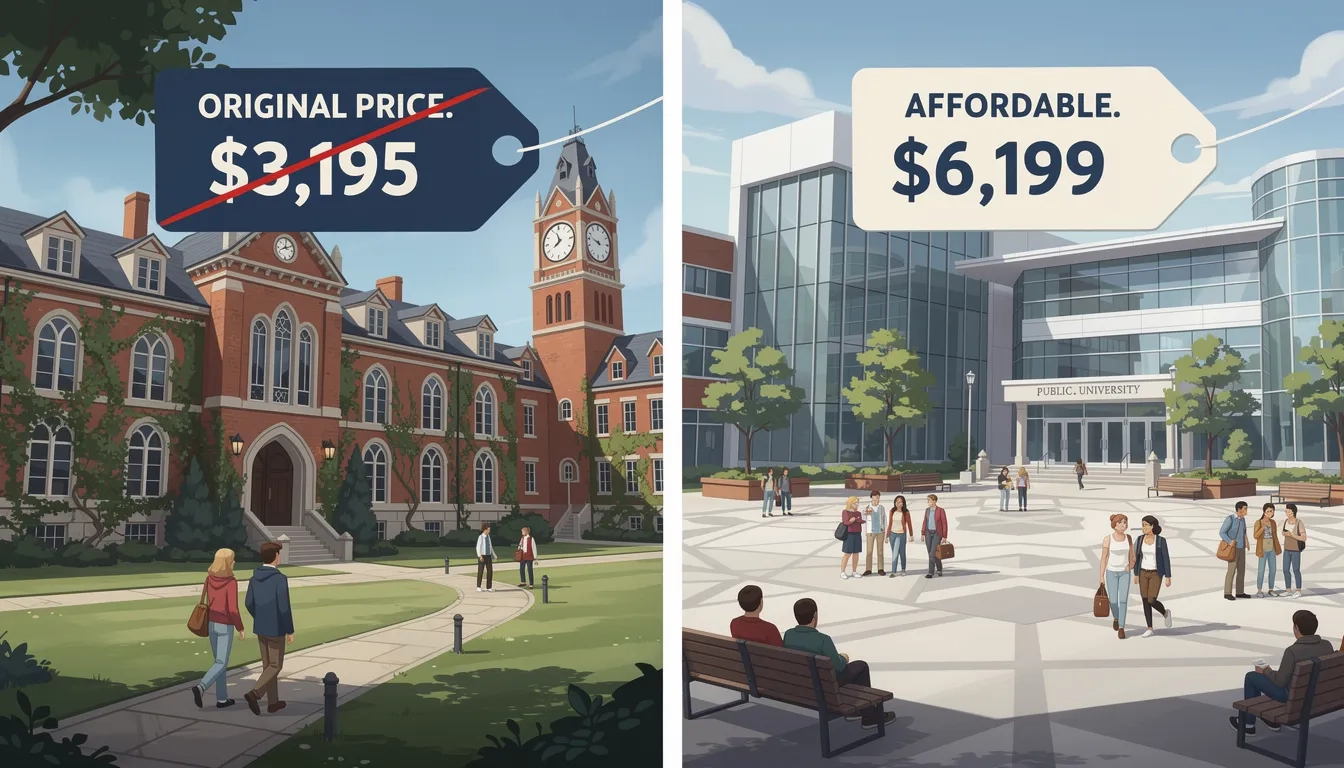
Most families look at the numbers and stop thinking. Public university: $11,950 in tuition. Private nonprofit: $45,000. Decision made — public wins by a landslide. But sticker price and what you actually pay are two entirely different things, and building your college list around published tuition figures is one of the most expensive mistakes a family can make.
The Sticker Price Is a Fiction
Private institutions now discount their listed tuition by an average of 56.3%, according to the National Association of College and University Business Officers' 2024-25 survey of 286 schools. That's the highest discount rate since 2015-16. The published price exists mostly as a negotiating anchor — not a realistic expectation of what you'll pay.
This does not make private schools automatically affordable. But it does mean you cannot evaluate this decision without actual financial aid letters in hand.
The gap between advertised and real costs has widened so dramatically that College Board's own 2025-26 pricing report flags it as one of the defining trends in higher education. Families who take sticker prices at face value are often ruling out schools that would have been their best financial option.
What You Actually Pay: The Net Price Breakdown
Once financial aid is applied, the cost gap between public and private narrows substantially. It doesn't disappear — but it looks very different from the headline numbers.
Here's what College Board's 2025-26 data shows for average net costs of attendance (tuition, room, board, fees):
| School Type | Avg. Net Tuition | Avg. Total Cost of Attendance |
|---|---|---|
| Public 4-Year (In-State) | $2,300 | $21,060 |
| Public 4-Year (Out-of-State) | $19,200 | $38,500 |
| Private Nonprofit 4-Year | $16,910 | $36,460 |
Two things stand out. In-state public remains the clearest financial win if you qualify. But out-of-state public ($38,500 all-in) costs more on average than attending a private nonprofit ($36,460). That reversal catches families off guard constantly.
The real comparison is never public vs. private in the abstract. It's your specific net price at each school you're seriously considering.
Living expenses now make up over 50% of total costs at many public universities, which means tuition headlines are often genuinely misleading. A school charging $6,000 in tuition in San Francisco can cost more to attend than one charging $18,000 tuition in rural Ohio.
The Academic Experience: What You're Actually Getting
Class size and faculty access diverge significantly between school types, and this matters more than most guides acknowledge. Large public universities — think the University of Michigan or the University of Texas at Austin — routinely put 200 to 400 students in introductory lecture courses. Smaller private colleges often cap the same courses at 25 to 30 students. That isn't just about comfort. Smaller classes correlate with stronger professor relationships, more useful recommendation letters, and more active learning for students who don't self-advocate aggressively.
But large research universities offer something smaller private schools often cannot match: serious research infrastructure. If you want to work in a lab as an undergraduate (this is especially relevant for pre-med and STEM students), a major public research university with $1.4 billion in annual research expenditures can be more valuable than a prestigious small liberal arts college.
Key differences worth knowing before you apply:
- Student-to-faculty ratio: Private nonprofits average about 12:1 vs. 18:1 at public four-year schools
- Programs offered: Large public universities typically list 300+ degree options; smaller privates may offer 60 to 80
- Division I athletics: Almost exclusively a large public university feature
- Alumni network intensity: Private schools often have smaller but more engaged alumni communities
Neither profile is universally better. What matters is which environment fits how you actually learn and what you plan to study.
Graduation Rates and What Happens After
Private nonprofit colleges graduate about 76% of students within six years. Public four-year schools land at 71%. That five-percentage-point gap sounds modest, but at the scale of U.S. higher education it represents hundreds of thousands of students who don't finish their degrees.
Some of this reflects who enrolls, not how well schools serve students. Private colleges typically attract students with stronger academic preparation and more family financial support, so the raw comparison is imperfect. But institutional factors matter too. Smaller schools with more hands-on advising and tighter community structures genuinely keep students enrolled through difficult stretches.
Career outcomes are harder to tie to institutional type than most guides suggest. The National Association of Colleges and Employers (NACE) found that 85.7% of Class of 2024 bachelor's graduates were employed or enrolled in further education within six months of graduation. That figure barely moved between public and private graduates.
Where the difference shows up is in debt. Private four-year graduates borrowed an average of $32,806 to complete their degrees, versus $25,549 for public university graduates. That $7,257 gap in starting debt is real — it translates into years of monthly payments. One counter-intuitive finding worth sitting with: economists analyzing outcomes from over 30 million students found that public universities deliver greater upward economic mobility than private schools, on average. Large public systems serve far more first-generation and lower-income students, and they graduate them into the middle class at scale.
The Out-of-State Trap
This is the elephant in the room that most comparison guides skip entirely.
Out-of-state tuition at public universities has been rising at 3.7% annually, per College Board's 2025-26 data. The average out-of-state student now pays $31,880 in tuition alone, before room, board, or fees. Add living costs and you're at $38,500 total — which, again, is more expensive than the average private nonprofit.
If you're applying out-of-state to public schools, you're usually not choosing a budget option over a premium one. You're comparing two similarly priced options, and the private school may offer more institutional aid.
A few strategies that actually help out-of-state applicants:
- Check regional exchange programs like the Western Undergraduate Exchange (WUE), which lets students from 16 Western states pay 150% of in-state tuition rather than full out-of-state rates at participating institutions.
- Some states have border-state reciprocity agreements that extend in-state pricing to neighbors.
- Flagship public universities increasingly award merit scholarships to attract out-of-state students — sometimes dropping costs below in-state rates at less selective schools in the same system.
How to Build a Smart Comparison List
Most students build their college list around prestige rankings, location, or a campus visit that felt right. That's fine — those things matter. But the smarter approach anchors the list on financial fit before application fees start stacking up. Students who begin this research in the spring of junior year can evaluate each school's aid policies before paying $85 application fees at a dozen schools they'd later reject on cost.
Here's a framework that actually works:
- Calculate your Student Aid Index (SAI) — the number FAFSA produces that tells schools how much your family is expected to contribute. This anchors everything.
- Identify which private schools meet full demonstrated need. About 60 U.S. schools, including all eight Ivy League universities, commit to meeting 100% of demonstrated need. For families earning under $65,000 annually, Harvard, Princeton, and Yale routinely produce $0 in tuition — this is not marketing language, it's their published policy.
- Run net price calculators before applying. Federal law requires every accredited institution to publish one. The results can be surprising in both directions — a school with a $52,000 sticker price might net out cheaper than a "affordable" state school across the country.
- Stack your projected debt against your expected starting salary. A useful rule of thumb: total student loan debt shouldn't exceed your first-year income in your chosen field. Planning to enter social work ($42,000 starting)? Borrowing $90,000 is a problem regardless of school type.
- Then weigh academic environment. Class size, research access, campus culture, location — evaluate these only after you have real cost figures to compare.
| Decision Factor | Likely Advantage |
|---|---|
| Lowest cost (in-state resident) | Public |
| Financial aid generosity | Elite Private |
| Small class sizes / faculty access | Small Private |
| Research funding and lab access | Large Public |
| Number of majors offered | Large Public |
| Six-year graduation rate | Private Nonprofit |
| Economic mobility outcomes | Public |
| Out-of-state affordability | Varies — check net price |
Bottom Line
The public-vs-private debate largely dissolves once you have actual financial aid offers. Before that moment, you're comparing hypotheticals. Here's what to do:
- Get your specific net price from every school you're considering seriously — use their net price calculator, not published averages.
- Don't assume out-of-state public is the budget pick. At $38,500 average all-in, it often isn't.
- If you're a strong student from a lower-income family, elite private schools can cost less than in-state public — and often do, once full-need institutional aid applies.
- Match the academic environment to how you learn. A student who thrives on individual mentorship won't get it at a 50,000-student flagship, regardless of price.
My take: for most middle-income families who won't qualify for substantial private institutional aid, in-state public universities offer the clearest path to a degree without damaging long-term finances. But "most" is doing a lot of work in that sentence. Run the real numbers for your specific situation — then decide.
Frequently Asked Questions
Is a private university degree worth more to employers than a public university degree?
Generally, no. Most employers don't distinguish between public and private when hiring for standard roles. What registers is your GPA, internships, skills, and the specific program's reputation in the relevant industry. A flagship public university's engineering program often carries more weight with regional employers than a lesser-known private school's equivalent. The prestige premium is real, but it attaches to elite institutions specifically, not to private schools as a category.
Can private colleges actually be cheaper than public universities?
Yes, in specific situations. In-state public tuition is hard to beat if you qualify. But for out-of-state applicants, or for families whose income qualifies them for strong institutional aid at private schools, the math can flip. Schools that commit to meeting 100% of demonstrated need — particularly the Ivy League and a handful of peer institutions — regularly produce total costs below $20,000 per year for families with household incomes under $75,000.
What is the real average student debt difference between public and private graduates?
Based on 2024 NACE data, private four-year graduates carry an average of $32,806 in student loan debt at graduation, compared to $25,549 for public university graduates. The $7,257 gap matters, but the more meaningful question is your debt-to-income ratio — your projected loan balance relative to your expected starting salary in your field. A nurse earning $68,000 can service $32,000 in debt far more easily than an art history graduate earning $38,000.
Myth vs. reality: do public universities have worse professors?
Myth. Faculty credentials at public and private universities are similar across the board. The meaningful difference is access and attention. At a small private college, you're likely to interact with senior faculty regularly throughout your undergraduate years. At a large public research university, you may share a lecture hall with a world-renowned professor and never speak to them once. Teaching-focused private colleges prioritize accessibility; research-focused public universities prioritize output and funded research — both models attract excellent faculty.
How do I find out which schools will give me the most financial aid?
Start with the net price calculator on each school's website (federally required to be publicly available). College Board's BigFuture platform aggregates these. Then check each school's "meets full demonstrated need" policy explicitly — institutions that commit to this without packaging loans into the aid offer are a fundamentally different financial proposition from schools that primarily offer merit scholarships or subsidized loan packages.
What's the biggest mistake families make when choosing between public and private?
Deciding on sticker price alone — in either direction. Students often eliminate private schools as unaffordable before checking their actual net price. They also pick public schools assuming lower cost, without accounting for out-of-state tuition surcharges, living costs in expensive cities, or weaker institutional grant aid. The decision should always begin with running actual net price numbers at each specific school you're considering, then factor in program quality, academic environment, and fit.
Sources
- The 2026 U.S. Tuition Fee Report: Trends in Public vs. Private University Costs
- Trends in College Pricing Highlights - College Board Research
- Average Private vs Public College Tuition [2025]: Data Analysis
- College Graduation Rates: Full Statistics | BestColleges
- Outcomes Rates Nudge Up for Class of 2024 Bachelor's, Master's Graduates - NACE
- The Cost of Private vs. Public Colleges - U.S. News