Making the Most of Office Hours: A Student's Practical Guide
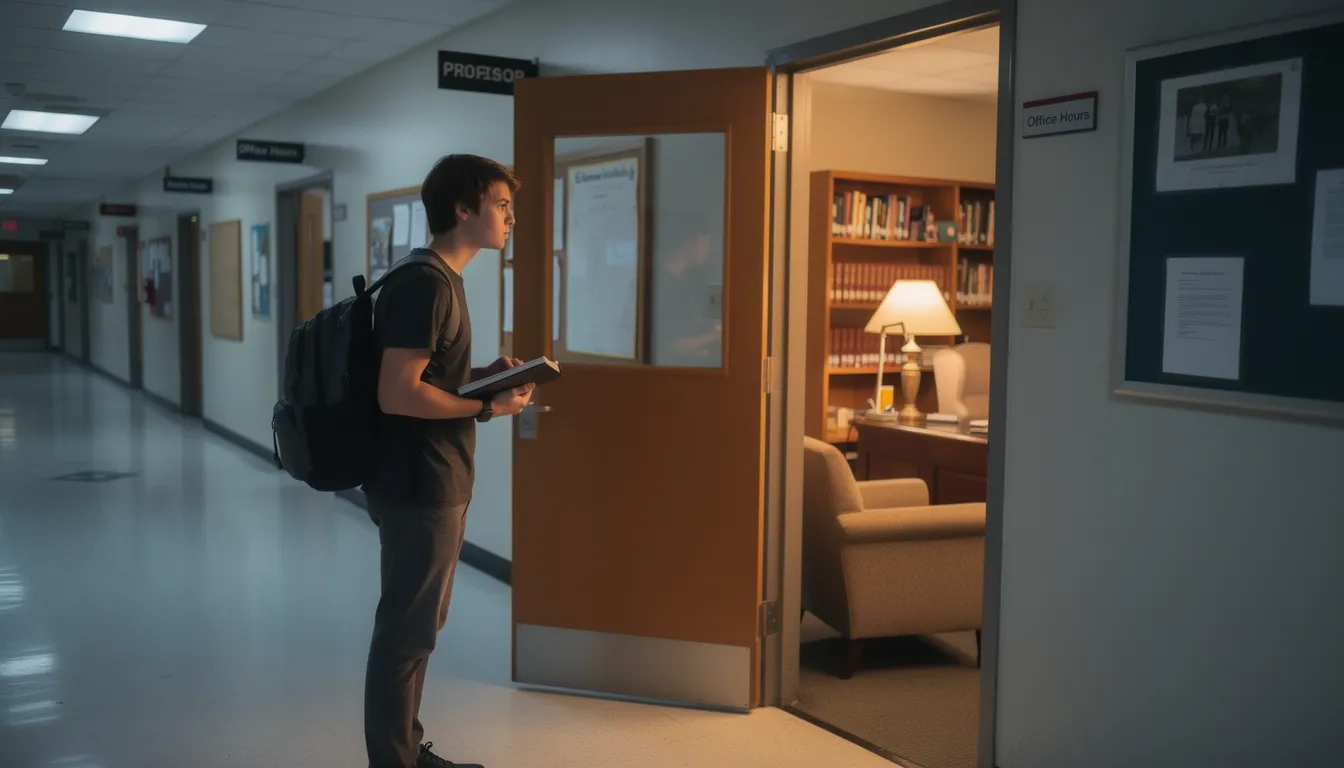
Across a typical semester, your professors collectively hold 2,700 minutes of scheduled one-on-one time just for students. No appointment required. No agenda. Those hours are built into the academic calendar and covered by tuition. Most of them go completely unused.
A 2022 survey found that 28% of college students never attended a single office hour session in a given term, and another 55% showed up only once or twice. The clear majority of students are walking past one of the most direct academic resources available — week after week, course after course.
This isn't a niche problem. It shows up at large research universities and small liberal arts colleges alike. And it's not from lack of awareness. Most students know office hours exist. The problem is a set of persistent myths that make the experience feel riskier or more awkward than it actually is.
Why Students Stay Away — And Why Those Reasons Don't Hold Up
The most common excuse is not wanting to "bother" the professor. This is almost always wrong.
Professors schedule those hours specifically to see students. Faculty who hold three hours of open office time each week across a 15-week semester are carving time out of days that are already packed with research, grading, and committee work. An empty chair isn't neutral to them. Most instructors find sustained emptiness discouraging, not peaceful.
The second myth — that office hours are only for struggling students — does real damage. It's completely backward. The students who tend to benefit most are those already engaged and curious: the one who wants to ask a follow-up question that lecture format doesn't allow, or who is choosing between two thesis directions and wants a faculty read before committing.
The naming issue matters too. George Fox University's political science department discovered that students were avoiding office hours because the phrase itself implied the professor was occupied with separate work. When the department switched their syllabus language to "visiting hours," attendance climbed. The label was doing damage the professor didn't even know about.
And on scheduling: one in five students who miss office hours do so purely because of time conflicts, according to reporting from Inside Higher Ed. That's a solvable problem. Ask the professor if there's another time that works. Most will accommodate a 15-minute appointment. The alternative — skipping entirely because the Thursday slot conflicts with your shift — costs far more than a short email.
Before You Walk In: How to Prepare
Preparation doesn't mean scripting a formal presentation. It means spending 10 minutes thinking through what you actually want to leave with.
Start with one specific question. Not "I'm confused about the last unit" — that's too vague to work with. Something like: "I understand how comparative advantage operates in a two-country model, but I'm not sure how it holds when one country has absolute advantage across every sector." That precision tells the professor exactly where you are, and the conversation can move forward immediately.
Think through what you've already tried. Professors get much more traction when students come in having attempted the problem themselves. It signals intellectual honesty — you're not asking for answers, you hit a genuine wall and you're being direct about it.
Before you go:
- Review your notes and mark the specific moment you got lost
- Write down two or three focused questions (you may not use all of them, but it helps to have backup)
- If it's about an assignment, bring the rubric and your most recent draft
- For a first visit, look up the professor's research interests on the department website
At Harvard, some lecturers have begun requiring brief office hour check-ins as part of their course structure, prompting students to arrive with a defined goal: "draft review," "concept check," or "career question." That framing eliminates awkwardness on both sides and makes every minute count.
What to Actually Talk About
Course content is the obvious entry point. But the most useful conversations often start somewhere less expected.
Getting specific feedback on returned work is one of the most underused applications of office hours. When you get a paper back with a 74 and a handful of margin notes, visiting to understand what would have made it stronger is worth far more than re-reading those comments alone. Ask directly: "If I revised this section, what would you need to see to consider it strong?" That question will teach you more about academic writing in 15 minutes than most rubrics convey across an entire semester.
Exam preparation also transforms inside office hours. Skip "what's going to be on the test" and instead ask which concepts students typically misapply in this course. Professors remember patterns across years of students. They know which mistakes come up every semester — and most are genuinely happy to tell you.
Here's a practical framework for matching situations to questions:
| Situation | What to Ask |
|---|---|
| Lost during lecture | "I lost the thread at [specific point] — can we rebuild from there?" |
| Got feedback you don't understand | "What would a strong version of this section actually look like?" |
| Preparing for an exam | "What do students most often misapply in this unit?" |
| Interested in the professor's research | "How did you get into this area? What would you suggest I read?" |
| Personal situation affecting coursework | "I've been dealing with [brief context]. What options do I have?" |
The last row matters. Honest communication about personal circumstances belongs in these conversations. If a health issue, family situation, or expanded work schedule is affecting your performance, telling the professor early gives them something to work with. Most want to help. They just can't do anything if they don't know what's happening.
The Long Game: What Office Hours Actually Build
Here's what most advice about office hours misses: the assignment you're asking about today is not the most valuable thing these conversations produce.
Letters of recommendation are the most concrete example. When a student asks a professor for a reference letter with two weeks' notice, the professor is essentially writing about a name on a roster. When a student has visited several times, asked substantive questions, followed through on advice, and shared what they're working toward — the professor can write something real. "She came to my office after the Tocqueville discussion with a question about the limits of pluralism that I still think about" is not a sentence any form letter produces.
Research assistantships, internships, and academic mentorship follow the same logic. Faculty can only refer students they actually know. And they get to know students through repeated, genuine office hours visits.
The research here is consistent across institutions. High-quality student-faculty interactions correlate with retention, academic achievement, and students' confidence in their own intellectual capacities — findings that show up repeatedly in higher education research. Going to office hours isn't transactional networking (a grim way to describe what's actually just a working relationship). It's participating in the educational structure the institution is built around.
The biggest mistake students make is waiting until something is urgent — a late extension, a last-minute reference letter — to introduce themselves to their professor for the first time.
Logistics, Timing, and Virtual Options
Go early in the semester. This is the single piece of advice faculty and academic support professionals return to most often, and it earns that consensus.
Visiting in weeks two or three, before anything is high-stakes, is a fundamentally different experience than showing up in week ten behind and stressed. The conversation is lighter, the professor is less inundated with urgent requests, and you're establishing yourself as a person before there's any reason you had to. It's dramatically easier to ask a casual question before the first exam than to walk in for the first time during finals week.
First-generation students face a specific version of this timing trap. The students with the most to gain from office hours are often least likely to go in those early weeks because there's no obvious crisis to justify a visit. If this describes you: go anyway. Introduce yourself. Ask what students typically find difficult in the course. That's a completely legitimate reason to show up, and it costs nothing except a 10-minute walk.
Virtual options now count as real options. After the pandemic, Bowdoin College found that 58% of students had come to rely on remote office hours. Schools like Holy Names University kept virtual sessions running post-pandemic because they demonstrably worked. A Zoom appointment is not a lesser experience — for students who work off-campus or have family responsibilities, it's often the only format that's actually accessible.
A few practical notes:
- Arrive five minutes before an open drop-in session to be seen first
- Introduce yourself by name and course section at the start; professors see many faces
- Take brief notes during the conversation — it signals engagement and helps you remember the advice
- Send a short follow-up email if the professor's suggestion actually helped; they remember those
Make It a Habit, Not a Rescue Operation
The students who get the most from office hours aren't the ones who appear in week fourteen in crisis mode, hoping a single visit will turn things around. They're the ones who treated it as a standing resource across the whole semester.
Three purposeful visits per course tends to accomplish far more than one frantic session near finals. Go early to introduce yourself and get oriented. Go mid-semester with a specific question about an assignment or a concept that keeps tripping you up. Go in the final stretch to close any remaining gaps before the last exam. That rhythm builds something — a real professional relationship — that a single visit never can.
Think of it this way: tuition already paid for access to expert instructors whose job explicitly includes meeting with you one-on-one. Not using that resource doesn't save you anything. You just leave value on the table.
Bottom Line
- Go before you need something. Visiting in the first two or three weeks, with no crisis attached, is the single highest-leverage move you can make. It changes every future interaction.
- Come with one specific question, not a vague sense of confusion. Precision makes the conversation useful for both of you.
- Think beyond the current assignment. The letters, research opportunities, and mentorship relationships that come from consistent office visits are worth more than any single grade bump.
- Don't let scheduling be a permanent block. Ask about appointment times outside posted hours. Most professors will say yes.
- Virtual counts. A Zoom visit is a real visit. Use whichever format you can actually attend.
Frequently Asked Questions
How often should I go to office hours?
Two or three times per course per semester is a solid target. One early visit to introduce yourself, one mid-semester visit tied to a specific assignment or concept, and one visit near the end to address remaining gaps covers the full arc of the course and builds a real working relationship without over-committing your schedule.
What if I don't have a specific question?
You don't need one. Introducing yourself and asking what students typically find hard in the course is a legitimate reason to visit. You could also ask about the professor's research, or what they'd recommend reading if you want to go deeper than the syllabus. Curiosity counts as a reason to show up.
Myth: Office hours are only for struggling students — true or false?
False, and this myth costs engaged students real opportunities. The students who get the most from office hours tend to be those already curious and performing reasonably well — students who want to push a concept further, explore a professor's research area, or get honest feedback on a draft before it's graded. Struggling students absolutely benefit too, but waiting until you're in trouble to make your first visit is a missed opportunity.
How do I bring up a letter of recommendation during office hours?
Don't ambush the professor on a first visit. Build the relationship first across a few visits, then ask directly and early — ideally months before you need the letter. When you do ask, give them context: what the letter is for, your relevant experience in their course, and what aspects of your work you'd like them to speak to. Professors write better letters when they're given something specific to work with.
What should I do if I'm nervous walking in?
That's normal, and most professors have seen it enough times that they know how to ease it. A simple structure helps: knock, introduce yourself by name and course, state what you came to talk about, and let the conversation take over from there. The first visit is always the hardest. After that, it gets easier every time.
Are virtual office hours as effective as in-person?
For most purposes, yes. A clear question, a focused conversation, and a follow-up email work the same way over Zoom as they do across a desk. For students who work, commute, or have caregiving responsibilities, virtual office hours are often the only format that's actually accessible — and that accessibility matters more than the medium.
Sources
- 2,700 Minutes: How to Make the Most of Your Office Hours | Faculty Focus
- Professors Promote Office Hours in Fresh Ways to Remove Barriers | Inside Higher Ed
- A Guide to Office Hours | Harvard College
- Want to Do Well in Your Courses? Attend Office Hours | University of Iowa CLAS
- How to Make the Most of Office Hours | UPenn Weingarten Center