Ivy League vs State School: Is the Prestige Worth the Price?
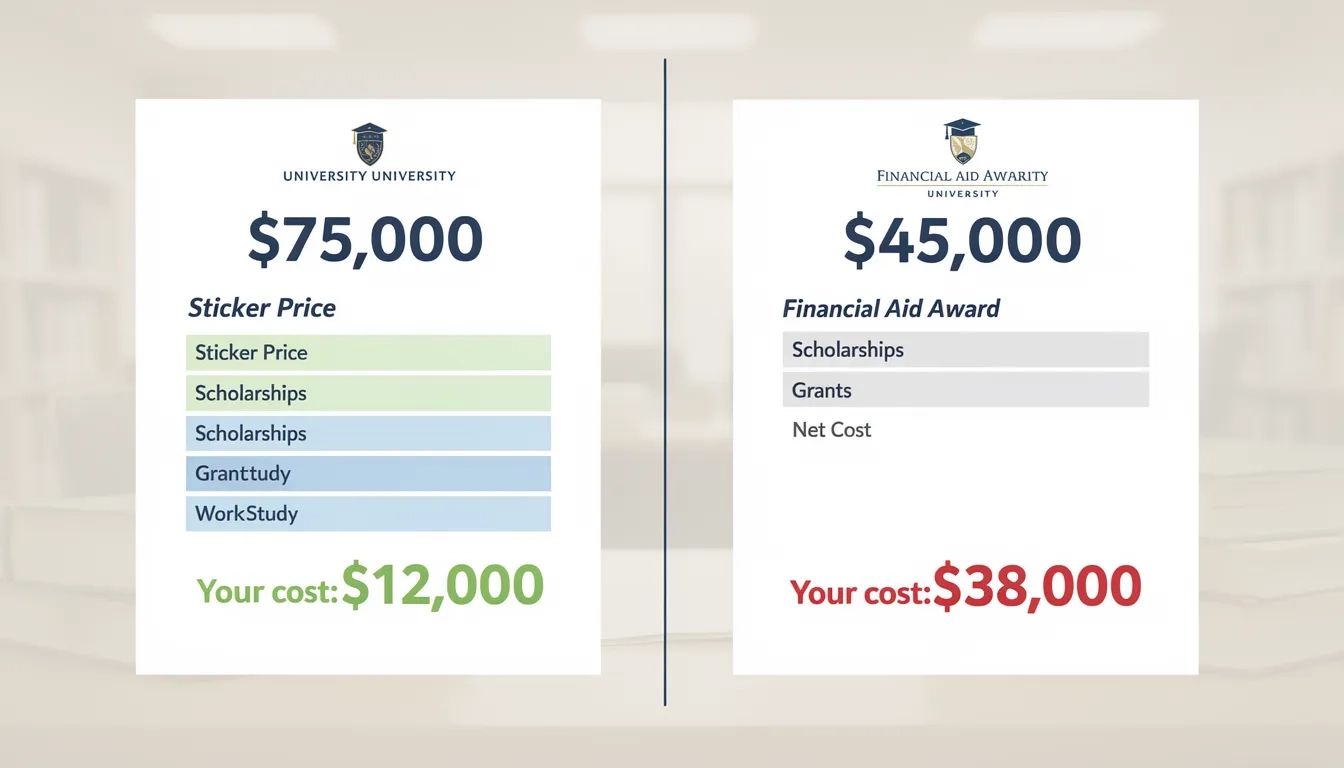
A family earning $75,000 a year might actually pay less to send their kid to Harvard than to their in-state flagship. Not a marketing line. Harvard's financial aid policy zeroes out tuition, room, and board for families earning under $85,000. Princeton's average aid recipient paid just $9,836 total in the 2024–2025 academic year — less than one semester's tuition at dozens of public universities.
So the question most families start with — "Can we even afford an Ivy?" — may be exactly the wrong question.
The Sticker Price Is Misleading
Ivy League schools post total annual costs of $88,000 to $98,000. For the 30 to 40 percent of students who pay full price, that number is real. For everyone else, it's largely theater.
The actual net costs after financial aid look dramatically different. Harvard, Yale, Princeton, and Columbia all have policies where families earning under $100,000 pay nothing or close to it. Federal College Scorecard data analyzed by Yahoo Finance shows Princeton's average annual net cost for aid recipients at $9,836 and Harvard's at $13,872.
State schools average $11,260 in-state tuition and fees. That sounds affordable until you realize public flagships often provide less generous need-based aid to middle-income families than the wealthiest privates do. A family earning $90,000 may genuinely pay less over four years at Princeton than at their home state university.
Run the net price calculators before you assume anything. Every Ivy has one. The results surprise most families who never check.
| School | Avg. Annual Net Cost (Aid Recipients) | 10-Year Median Earnings |
|---|---|---|
| Princeton | $9,836 | $95,689 |
| Harvard | $13,872 | $84,918 |
| Yale | $15,296 | $88,655 |
| Columbia | $22,823 | $89,871 |
| UPenn | $25,046 | $103,246 |
| Avg. State Flagship (in-state) | ~$25,000–$30,000 total COA | $60,000–$80,000 |
What the Salary Data Shows — and What It Hides
Ivy League graduates earn more. Early-career median pay for Ivy grads runs approximately $86,025, compared to $58,643 for graduates of other four-year universities. Mid-career, the gap stretches to $161,888 versus $101,777.
Those numbers look compelling. But they carry a serious selection problem. The people who get into Ivy schools are already exceptional — driven, high-achieving, and usually from well-resourced households. When you hold ambition and ability constant, the school's influence on salary shrinks considerably.
Economists Stacy Dale and Alan Krueger studied exactly this. Their research, replicated across two papers, found that students admitted to elite schools who chose to attend less selective ones earned salaries nearly identical to peers who enrolled at the elite institutions. The ambition the student brought mattered. The school's name, much less so.
The Research Fight: Dale-Krueger vs. Chetty
The Dale-Krueger findings held up for roughly two decades. Then a 2023 paper from Opportunity Insights — led by Raj Chetty at Harvard — challenged them directly.
The Chetty team found that attending an Ivy-Plus college increases mean earnings by $101,000 at age 33, compared to what the same students would have earned at state flagships. The state flagship counterfactual sat at roughly $143,000. At Ivy-Plus schools, it jumped toward $244,000 for comparable students.
The key distinction between these studies is the mechanism. Dale and Krueger controlled for student ambition. Chetty's team found that even after accounting for student quality, Ivy attendance conferred a premium — but that premium was heavily concentrated in specific industries. Finance, consulting, and law showed large effects. STEM fields outside elite tech firms showed much smaller ones.
"Attending an Ivy-Plus college increases access to certain professional networks and employers in ways that attending a state flagship simply does not replicate — particularly in finance and consulting." — Opportunity Insights, 2023
The two studies aren't really contradicting each other. They're measuring different things. Dale-Krueger says: ambitious students succeed anywhere. Chetty says: in industries with prestige-gated pipelines, the school genuinely changes your ceiling. Both are right, in different contexts.
Where the Prestige Premium Is Real
Certain industries recruit in ways that make your undergraduate institution matter far more than any guidance counselor wants to admit. Goldman Sachs, McKinsey, Bain, and BCG maintain explicit target school lists. They send recruiters to specific campuses, build relationships with specific faculty, and fill analyst classes from a short list of institutions.
Getting into those firms from a non-target school isn't impossible. It just requires working around the system rather than through it. The Ivy applicant walks through the front door. Everyone else finds a side entrance and knocks harder.
Fields where the prestige pipeline is concrete:
- Investment banking and private equity
- Management consulting at the top firms (McKinsey, Bain, and BCG have well-documented target school recruiting lists)
- Big Law (Magic Circle firms and top American firms heavily favor graduates of T14 law schools, which skew toward Ivy undergrads)
- Tenure-track academic positions in humanities and social sciences
- Certain competitive federal programs like the Presidential Management Fellows
This is not a moral argument about whether those industries should operate this way. It's just how they work. If your target career lands on that list, school choice is a strategic decision with real consequences.
Where State Schools Win
Engineering is the clearest case where the prestige calculus breaks down. According to The College Funding Coach's analysis, the average starting salary gap between a University of Pennsylvania engineering grad and a Texas A&M engineering grad is less than $1,000. The four-year tuition difference between those schools can exceed $167,000. You'd need generations at that marginal salary advantage to recover the cost difference.
Computer science, nursing, accounting, and most health sciences follow nearly identical patterns. Employers in technical and clinical fields care about demonstrated skills, portfolio quality, and licensure — not the logo on your transcript. A Michigan computer science grad and a Yale computer science grad are essentially interchangeable at most tech hiring desks.
Bloomberg's 2024 college ROI analysis confirmed this. After elite privates, large public universities dominate 10-year and 20-year return-on-investment rankings. Georgia Tech, the University of Florida, and several other state flagships consistently outperform well-regarded private colleges on net value. The math is straightforward: lower cost in, competitive salary out.
One thing the ROI rankings don't capture: student debt constrains career choices in ways that don't show up in salary comparisons. A graduate carrying $150,000 in loans (plausible for a high-income family paying near full price at an Ivy) faces fundamentally different choices at 24 than one who graduated debt-free. Career pivots, entrepreneurial bets, lower-paying public service work — all become harder when the loan statement arrives monthly. That constraint rarely appears in the prestige conversation but matters enormously in the real one.
How to Actually Decide
The right framework depends on two variables: your family's actual net cost and your target career path. Here's how to think through it without guessing.
Step 1: Run the net price calculator at every school you're considering. Do this in the fall of junior year, not after offers arrive. Many families are shocked to find their Ivy net price is lower than their state school's out-of-pocket cost. The net price tool at each school takes about 15 minutes and changes the entire conversation.
Step 2: Map your career goal against the prestige pipeline. If you want to be a software engineer, the school's name helps modestly. If you want McKinsey in three years, it matters substantially. Be honest with yourself here — aspirations and realistic plans aren't always the same thing.
| Career Goal | Does Prestige Matter? | Better Bet |
|---|---|---|
| Investment banking / PE | Yes, significantly | Target school or strong alumni network |
| Top-tier consulting | Yes | McKinsey/Bain/BCG have explicit target lists |
| Software engineering | Rarely | Skills, portfolio, FAANG internships |
| Medicine / healthcare | Minimally | GPA and MCAT scores dominate |
| Engineering / STEM | Rarely | Flagship state schools offer near-identical outcomes |
| Academia (humanities) | Yes | PhD placement rates favor Ivy feeders |
| Entrepreneurship | Minimally | Network helps; execution matters more |
Step 3: Model the debt differential, not just the salary. A $120,000 gap in student debt between two options isn't just a number — it's approximately 2.5 years of take-home pay for a typical entry-level professional (after taxes and living expenses). That's real money with real consequences in your 20s.
The Gallup-Purdue Index, which surveyed 30,000 college graduates, found no correlation between school selectivity and long-term job satisfaction or reported well-being. So the prestige premium lands in your paycheck, not your happiness. Factor that into what you're actually aiming for.
My honest read: for most students in most fields, paying full or near-full price for an Ivy League school is not worth it. The salary premium doesn't hold when you control for student ambition, and the debt load that comes with sticker-price enrollment suppresses career flexibility in ways that compound for years. But for families who qualify for generous aid — and for students targeting finance, consulting, or Big Law — the Ivy choice is often the financially smarter one. The answer lives in your specific numbers and career, not in a generalized ranking.
Bottom Line
- Check net costs before ruling anything out. Princeton's average aid recipient paid $9,836/year in 2024–2025. Many middle-income families pay less at Ivies than at their in-state flagship.
- Your career target is the deciding variable. Finance, consulting, and law have prestige-gated pipelines. STEM, healthcare, and most business roles largely don't.
- Student debt constrains more than a slightly higher salary restores. $150,000 in loans affects your choices at 24, 28, and 32 in ways that the raw earnings comparison misses.
- State flagship schools dominate ROI rankings in most technical and professional fields. Bloomberg's 2024 analysis found public universities lead on 10-year and 20-year net value in most categories.
- If a strong state school offers full or near-full funding and you're not targeting the prestige-gated industries, take the scholarship.
Frequently Asked Questions
Can an Ivy League school actually be cheaper than a state school?
Yes, for many families. Harvard zeroes out costs for families earning under $85,000. Princeton's average financial aid recipient paid $9,836 in 2024–2025 — less than in-state tuition at multiple public universities. Middle-income families earning $75,000 to $150,000 should run the Ivy net price calculators before making assumptions about affordability.
Doesn't the Dale-Krueger study prove the Ivy League brand doesn't matter?
Mostly, but not entirely. Dale and Krueger found that students admitted to elite schools who attended less selective ones earned similar salaries — pointing to ambition over institution. The 2023 Opportunity Insights paper by Raj Chetty found real earnings premiums for Ivy grads, but those premiums concentrate heavily in finance, consulting, and law. Outside those industries, the Dale-Krueger thesis largely holds.
Which careers benefit most from an Ivy League degree?
Investment banking, management consulting at top firms, Big Law, and tenure-track academic careers in humanities show the largest concrete benefits from elite credentials. These industries actively use school prestige as a hiring filter. Software engineering, healthcare, and most STEM fields show minimal prestige premium over strong state school alternatives.
Is it worth taking on debt to attend an Ivy League school?
It depends entirely on your career path. A Harvard economics grad joining Goldman Sachs at $120,000 can realistically clear $200,000 in debt within five years. A social work or education major from any Ivy carrying that same debt faces a very different calculation. Before borrowing, model the actual starting salary in your field against realistic loan repayment timelines — not median Ivy earnings across all majors.
What if I get into both an Ivy and a flagship state school?
Run the net price numbers on both, then compare the actual gap. If the Ivy's net cost is within $15,000–$20,000 per year of the state school and your target career benefits from elite recruiting, the Ivy is worth serious consideration. If the state school offers a substantial scholarship and you're studying engineering, computer science, or healthcare, take the scholarship.
Is the Ivy peer network really worth the cost premium?
The peer network is genuinely valuable — Chetty's research identifies it as a central mechanism behind the earnings premium, not just the credential itself. But building a strong professional network at a state flagship is completely achievable through deliberate effort: faculty mentorships, competitive internships, and professional organizations. The Ivy network is a faster on-ramp. It's not the only road.
Sources
- Best Colleges 2024: After Ivy League, Public Schools Offer Higher ROI — Bloomberg
- Diversifying Society's Leaders? The Causal Effects of College Admissions — Opportunity Insights / NBER
- Student Loan Debt vs. Salaries: Does an Ivy League Degree Actually Pay Off? — Yahoo Finance
- Ivy League vs State School Tuition 2025: The Complete Cost Comparison Guide — New Grads Info
- The Truth About Ivy League Tuition: Why That $90K Price Tag Is Misleading — Admissionado
- Median Income Earned By Ivy League Graduates — Financial Samurai