How to Evaluate a College Academic Calendar
Most students spend weeks agonizing over campus culture, rankings, and dorm layouts. The academic calendar? They barely glance at it. That's a mistake — the calendar structure shapes nearly every part of your college experience, from how quickly you burn out to whether you can land a summer internship without scrambling to finish finals in June.
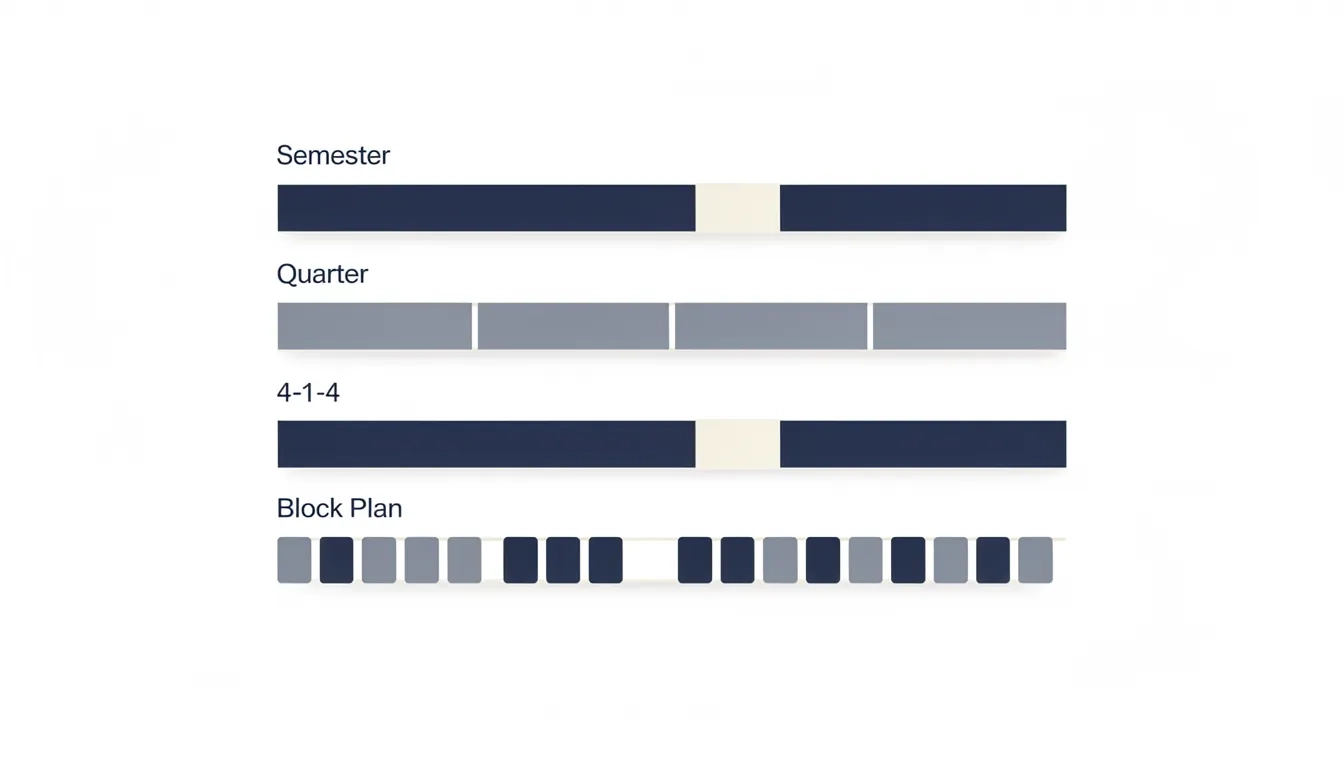
Colleges in the US run on four main systems: semester, quarter, trimester, and 4-1-4. About 90% of American colleges use the semester model. If a school you're considering runs on quarters, it's worth pausing to understand what you're actually signing up for.
The Four Systems, at a Glance
Before evaluating anything, you need a baseline on each type.
Semester splits the year into two 15-to-18-week terms. Fall runs roughly August through December; spring goes January through May. Students typically carry 4 to 6 courses per term.
Quarter divides the year into three or four 10-to-12-week terms. Most quarter schools run fall, winter, and spring, with an optional summer quarter. You take 3 to 4 classes each quarter — which sounds lighter, but the pace is anything but.
Trimester functions similarly to quarters but runs three roughly equal sessions. Less common in the US, though more widespread in Europe and Australia.
4-1-4 runs two four-month semesters with a one-month "January Term" (J-Term) between them. During J-Term, students focus on a single intensive course, project, or travel experience rather than juggling multiple subjects at once.
| System | Term Length | Courses/Term | Notable Schools |
|---|---|---|---|
| Semester | 15–18 weeks | 4–6 | ~90% of US colleges |
| Quarter | 10–12 weeks | 3–4 | Stanford, UCLA, Northwestern, Dartmouth |
| Trimester | ~12 weeks | 3–4 | Less common in US |
| 4-1-4 | 4 months + 1 month | 4 + 1 intensive | Middlebury, Elon, Williams, Colby |
Learning Pace: Depth vs. Variety
This is where the rubber meets the road for most students.
Semester students get time to sit with hard ideas. A 15-week term means your organic chemistry professor can slow down on a tricky mechanism without the whole course falling behind schedule. You have room for a stumble, a rethought approach, a week where life intervenes.
Quarter students experience the opposite. Ten weeks is not a lot of runway. By week two, you're already supposed to be keeping up.
The genuine upside of quarters: more shots. A lousy professor, a subject that doesn't click, a rough few weeks? On quarters, it's over in 10 weeks and a new term begins. On semesters, you're riding out 18 weeks of it.
The other real advantage is variety. Over four years, quarter-system students can fit roughly 36 courses into their schedule compared to about 32 for semester students (assuming similar credit loads per term). That's meaningful if you want to double major or explore widely before locking in on a path.
The Stress Curve Is Different Than You'd Expect
A common assumption: quarters must be more stressful because they're faster. The reality is more complicated.
Quarter exams hit in a compressed window, but each one carries less weight. You're not betting your semester GPA on a single midterm. Semester students often describe a calm mid-term stretch followed by a brutal finals period where everything converges at once.
Catapult College Counseling points out that students with learning differences often fare better in semesters because they need more processing time. But students who struggle with prolonged stress or time management sometimes do better in quarters precisely because the term ends before everything can spiral.
Neither system is inherently less stressful. They're differently stressful. The question is which kind breaks you down — the sprint or the marathon.
Know your answer before you enroll.
Internships and Recruiting: The Calendar Mismatch
This is the thing most college comparison sites don't address directly.
Most employers structure recruiting around the semester calendar. Summer internship programs in finance, consulting, and tech tend to run June through August — a schedule baked around students who finish finals in early May.
Quarter schools typically run spring quarter into late May or early June. That means quarter students may start summer internships several weeks after their semester peers, which can knock them out of programs with fixed start dates. Stanford and UCLA (both quarter schools) have navigated this for decades, but it requires students to plan carefully and sometimes negotiate start dates with employers.
Study abroad has the same wrinkle. Many international exchange programs are built around semester timing, so quarter students face fewer clean options and sometimes need to take a leave of absence to make it work.
That said, schools like Northwestern and University of Chicago operate on quarters and still produce strong recruiting outcomes. The calendar mismatch is a friction point, not a dealbreaker. But it's real friction — and worth factoring into your decision rather than discovering it sophomore year.
The 4-1-4 and J-Term: A Genuinely Underrated Structure
The 4-1-4 calendar doesn't get nearly enough credit from students or parents evaluating schools.
The January Term creates a dedicated experimentation slot that simply doesn't exist in a standard semester or quarter schedule. Middlebury College, Elon University, Williams College, and Colby College all offer formal J-Terms. MIT's version, called the Independent Activities Period (IAP), runs four weeks each January and offers more than 600 sessions covering everything from quantum computing research to stand-up comedy.
Students use J-Term for things that are awkward to fit into a regular semester: a compressed study abroad trip, a for-credit internship, independent research, or a course entirely outside their major. It functions as a built-in reset between December finals and February's spring start.
The tradeoff is real. J-Term can carry additional fees, and for students who genuinely need a break after fall exams, the implicit pressure to "do something productive" with January can feel like another obligation rather than breathing room.
My take: for students who like intensity in focused bursts but need recovery time between them, 4-1-4 is probably the best-designed calendar of the bunch. It's built around human energy cycles in a way that neither pure semesters nor quarters quite achieve.
Block Plans: The Outlier Worth Knowing
A few schools take the calendar experiment further.
Colorado College uses the block plan, where students take exactly one course at a time for 3.5-week blocks. The entire day is dedicated to that single subject. You complete roughly eight courses per academic year — the same quantity as a semester school, just sequential rather than simultaneous.
The block plan suits students who hate context-switching between three or four subjects each day. It also works well for certain learning styles where deep, sustained focus is an asset. But if a block goes badly — wrong course, poor professor fit, a personal crisis — there's no other class to retreat to. That block is your whole world for 3.5 weeks.
Credit Transfer: The Practical Math
If there's any chance you might transfer schools, run these numbers before you enroll — not after you've completed two years of coursework.
The standard formula: Quarter Credits × 2/3 = Semester Credits. So 180 quarter credits converts to 120 semester credits, which matches a standard four-year bachelor's degree. The aggregate works out. But course-by-course conversions are messier.
A 4-credit quarter physics class might not satisfy a 3-credit semester prerequisite at your target school. Or the receiving institution might require minimum semester hours that your quarter course doesn't quite hit. This matters especially for nursing programs, education licensure tracks, and any field with rigid prerequisite credit-hour requirements. Check specific transfer agreements now — don't assume it'll resolve itself later.
Reading Periods and Finals Schedules: The Details That Shape Your Life
Within whichever system a school uses, look closely at two calendar features most students skip right over: reading periods and finals end dates.
Some schools schedule 2 to 4 dedicated reading days between the last class session and the first final exam. Others go straight from lectures to finals with 24 hours of transition. Columbia University, for instance, builds explicit reading days into its December schedule before finals begin — a structural choice that has real consequences when you're sitting down to study for three exams back-to-back.
Also look at when finals actually end:
- Schools finishing finals before December 20 give students real holiday break time
- Schools running finals into December 22 or 23 create genuine pressure
- Spring semester start dates matter if you work during breaks or have family commitments
These aren't dramatic differences on paper. But when you're three exams deep with a flight to catch, those extra reading days feel like everything.
How to Actually Evaluate Any School's Calendar
Pull up the school's registrar or academic affairs website and work through these questions:
Pace and learning fit:
- How long is each term? Does that match how you learn — steady depth, or faster variety?
- If you have a rough start to a term, how much runway do you have to recover?
External alignment:
- When does spring term end? Will you conflict with internship start dates?
- Are study abroad options built around your term structure, or will you need special arrangements?
Special structures:
- Is there a J-Term, IAP, or block period you could use strategically?
- Does the January Term cost extra, or is it included in tuition?
Stress pattern:
- Are exams spread across short terms, or concentrated at the end of long ones?
- How many dedicated reading days does the school build in before finals?
Transfer contingency:
- If you might transfer, what's the specific credit conversion policy at your likely target schools?
Bottom Line
The academic calendar is not a footnote. It is the operating system your education runs on.
- If you learn best with time to process ideas, a semester school likely fits better. Fifteen weeks isn't slow — it's room to think.
- If you thrive on variety and recover fast, a quarter system might suit you. But verify internship timing before assuming the calendar won't create friction.
- If you want a structured slot for experimentation, look seriously at 4-1-4 schools like Middlebury or Elon. J-Term is one of the most underused advantages in college planning.
- If there's any chance you'll transfer, run the credit math now.
The calendar tells you how a school thinks about time, learning, and student energy. Reading it carefully takes 20 minutes. Not reading it can cost you an entire semester of misalignment.
Frequently Asked Questions
What is the most common college academic calendar in the US?
The semester system is by far the most widely used, covering roughly 90% of American colleges and universities. Two 15-to-18-week terms — fall and spring — form the core academic year, with optional summer sessions at many schools.
Does attending a quarter school hurt my chances for summer internships?
Not necessarily, but it creates scheduling friction. Quarter schools typically run spring term through late May or early June, while most structured summer programs in finance, tech, and consulting start in early to mid-June. Students at schools like UCLA or Northwestern do land competitive internships — they just often need to negotiate start dates or target programs with flexible timing. Plan for it early rather than discovering the conflict during junior year recruiting.
Is it harder to transfer credits from a quarter school to a semester school?
It can be tricky. The conversion formula — quarter credits × 2/3 = semester credits — works cleanly in aggregate, but individual course equivalencies don't always align. Fields with specific prerequisite hour requirements (nursing, education, engineering) are especially prone to gaps. Always check the target school's transfer credit policies before assuming a smooth transition.
Myth vs. Reality: Is the quarter system harder than semesters?
The quarter system is faster, but not necessarily harder. Quarter exams hit more frequently, but each individual assessment carries less weight on your overall GPA. Semester systems move more slowly yet concentrate stress into fewer, higher-stakes exam periods. Counselors and researchers consistently find that neither system produces better grades across the board — students who match the calendar structure to their learning style outperform those who don't, regardless of which system it is.
What is a J-Term, and which schools offer it?
A J-Term (January Term) is a one-month intensive session built into the 4-1-4 calendar structure, typically sitting between fall and spring semesters. Schools like Middlebury College, Williams College, Elon University, and Colby College offer formal J-Terms. MIT runs a comparable program called the Independent Activities Period (IAP), offering more than 600 sessions in January spanning research projects, professional seminars, and recreational courses.
How do I find accurate calendar details for a school I'm evaluating?
Go directly to the school's registrar or academic affairs website — not the admissions page, which is often vague. Look specifically for: term start and end dates, finals schedules, and reading day policies. If the website doesn't answer your questions, call the registrar's office. Ask: "When do spring finals end?" and "Do you have dedicated reading days before exams?" You'll get a direct, specific answer in about 7 minutes — more useful than anything a rankings site will tell you.
Sources
- Semester vs. Quarter System in College
- Understanding the 4-1-4 Academic Calendar
- Choosing Between Quarter and Semester Systems
- Introduction to College Academic Calendars: Semester, Quarter, Trimester, and 4-1-4 Systems
- Financial Aid and Study Abroad: Basic Facts for Students
- Types of Academic Calendars