How California can stop losing great teacher candidates before they start
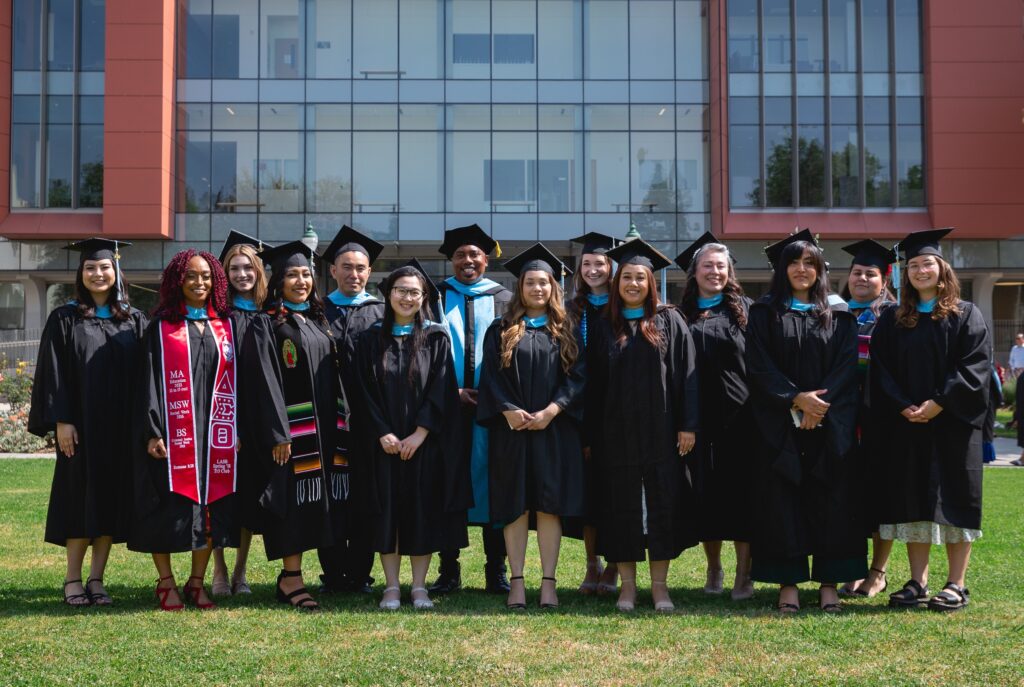
Tylyn Fields and her cohort of Teacher Residents celebrating together at Alder Graduate School of Education’s graduation in 2023.
Courtesy: Alder Graduate School of Education
During California’s most recent teacher shortage, Tylyn Fields, a trained social worker, saw teaching as a calling and a promising career. Smart and motivated to make a difference, she was an excellent candidate for the high-need schools in the community where she lived and worked. Sadly, her research into teacher education revealed an impossible choice. A quality preservice program would require her to quit her job for a year of unpaid coursework and student teaching. Taking out more loans was a nonstarter; she already owed thousands for previous student loans.
We desperately need more well-trained teachers across the state. And while countless aspiring teachers are eager to make a difference in their communities, the financial barriers to entering the profession are pushing promising candidates toward emergency credentials or away from teaching altogether. Teaching is a public service profession. For too many, their future earnings as public school teachers are not enough to pay back the upfront costs of preparation, causing them to enter the profession as an intern with little or no training so they can earn a salary, or simply give up on the idea of becoming a teacher.
California has made impressive progress in recent years on this issue. In 2019, the state started investing in the Golden State Teacher Grant (GSTG) program, which offers $20,000 tuition grants for teacher candidates who commit to working in high-need schools. And over the past five years, the program has prioritized the candidates who need the funding most and who seek meaningful teacher preparation before becoming teachers.
The GSTG program has made an extraordinary difference for thousands of teachers, including Fields. At the Alder Graduate School of Education, we focus on community-based recruitment of aspiring teachers, and we’ve seen a significant jump in applications thanks to the grants. Without the financial support from the state, Fields said she would have waited until she could pay off her student loans — about 10 years, she estimated.
To extend allocated funding for longer, grant awards were cut by half — to $10,000 — and the funding has run out. The governor’s revised May budget for 2025-26 includes $64.2 million for the Golden State Teacher Grant program, which is barely enough to extend it for one more year. By the time the funding can be signed into law, teacher candidates will already be enrolled in programs, potentially reducing recruitment.
We propose three big ideas to better support California’s teacher preparation pipeline.
- Establish consistent financial aid for aspiring teachers so that districts and preparation programs can share reliable recruitment offers with candidates. Multiyear funding for the program is one way to do this and would allow for more reliable messaging to candidates. Another could be a teacher candidate loan program that could draw from Proposition 98 funds, which are somewhat shielded from the volatility of California’s general fund.
- Create a layered system of needs-based financial support, with baseline financial support for those meeting the criteria, and layered support for candidates who commit to a high-need subject, school or region. This would broaden access for lower-income individuals while giving the state tools for influencing candidates’ choices.
- Restructure aid such that preservice preparation can compete with the financial appeal of emergency pathways. Ideally, candidates could earn pay and benefits while they learn to teach and have their training costs paid for. We wisely do this for Army and police cadets because it’s unthinkable that we’d send them directly to the field without training or have them pay for their training. Similarly, teacher candidates should be paid for their pursuit of this public service profession.
In these tight budget times, the most helpful short-term action is to increase the proposed Golden State Teacher Grant reinvestment to cover at least two or three years of awards to make it more useful for teacher recruitment.
Let’s end with some great news. After enrolling in Alder’s preservice residency program, Fields graduated a year later with a teaching credential and a master’s degree in education. She took a job as an elementary school teacher in her local district. She is about to enter her third year of teaching, and she is thriving. Her students, principal and colleagues are grateful she was able to become a teacher. As a state, let’s continue to push forward with the good reforms we started six years ago, so that many more candidates like Fields can find their way to the classroom.
•••
Heather Kirkpatrick is CEO and president of Alder Graduate School of Education, a nonprofit, community-based, professional workforce development pathway that partners with public TK-12 school systems across California.
The opinions expressed in this commentary represent those of the author. EdSource welcomes commentaries representing diverse points of view. If you would like to submit a commentary, please review our guidelines and contact us.