Duke vs UNC: The Definitive North Carolina College Comparison
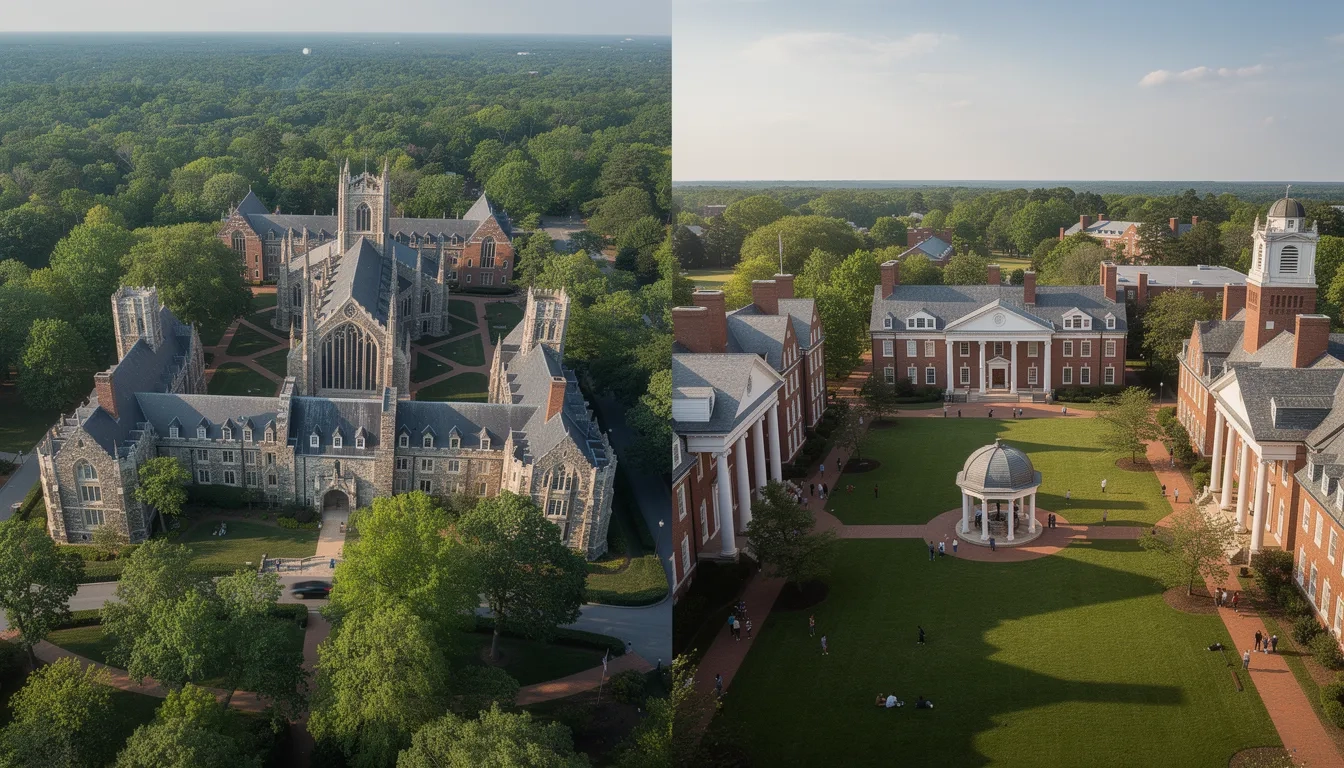
Eight miles. That's how far Duke University in Durham sits from the University of North Carolina at Chapel Hill on a clear day with no traffic. Yet the students at these two schools don't just go to different universities — they inhabit different identities, different social worlds, different ideas about what college is supposed to be. One is private, elite, and ferociously selective. The other is a flagship public institution with a global reputation and a price tag that, for North Carolina residents, borders on extraordinary. Choosing between them isn't just a college decision. For thousands of families each year, it's a statement about priorities.
Two Schools, One State — The Basics
Duke University sits on a Gothic campus in Durham, a city that has spent the last decade reinventing itself as a food, arts, and tech destination. The campus architecture alone is worth a visit — its cathedral-like Duke Chapel was built in the 1930s using funding from the Duke tobacco family. Enrollment sits around 6,800 undergraduates, structured through a residential college system designed to create tight-knit communities from day one.
UNC Chapel Hill, founded in 1789, was the first public university in the United States to actually open its doors. (UNC will mention this frequently, and honestly, the flex holds up.) It enrolls roughly 19,000 undergraduates — nearly three times Duke's count — giving it the breadth and social energy of a genuine flagship. The surrounding town wraps itself around the university in a way that feels almost symbiotic.
| Factor | Duke | UNC Chapel Hill |
|---|---|---|
| Type | Private | Public |
| Undergrad enrollment | ~6,800 | ~19,000 |
| U.S. News ranking (2025) | #6 | #27 |
| In-state tuition | $63,450 | $7,019 |
| Out-of-state tuition | $63,450 | $37,360 |
| Acceptance rate | 5.7% | 18.7% |
| Median SAT | 1540 | 1343 |
These numbers tell a story. But they don't tell the whole one.
Rankings and Academic Reputation
Duke climbed to #6 nationally in the 2025 U.S. News Best Colleges rankings — its highest position since 2006, tied with Caltech, Johns Hopkins, and Northwestern. That's not just marketing. It reflects real institutional strength in research output, faculty quality, student outcomes, and financial resources.
UNC slipped a few spots to #27 overall in 2025, but that number undersells what the school actually is. As a public university, UNC ranks among the top five public institutions in the country. Being 27th in America while simultaneously cracking the top-five public school list is a genuinely difficult thing to pull off.
The QS World University Rankings for 2026 place Duke at 62nd globally and UNC at 140th. Both are elite by any reasonable global benchmark.
Where they differ sharply is field-specific reputation:
- Duke: Engineering, Medicine, Law (all top 20 nationally), Neuroscience, Public Policy, Nicholas School of the Environment
- UNC: Public Health (UNC's Gillings School of Global Public Health consistently ranks top 5 worldwide), Journalism, Pharmacy, Library Science, Social Work
If your goal is a career in global health policy, UNC's institutional network is arguably superior to Duke's. If you want to go into investment banking, consulting, or biomedical research, Duke's name and alumni connections carry specific leverage in those rooms.
"Both schools can open doors. The question is which doors you're trying to walk through."
Getting In — The Numbers Behind the Door
Here's the elephant in the room when you put these two schools side by side: getting into Duke operates in a categorically different difficulty bracket than UNC.
Duke's acceptance rate for 2024-2025 was 5.71%. The median SAT is 1540, the median ACT is 35. Those numbers put Duke in the same tier as Penn, Dartmouth, and Cornell — schools where near-perfect grades are necessary but not sufficient. The students who get in typically have something beyond the numbers: research, unusual achievements, or a narrative that makes a compelling case.
UNC's acceptance rate sits at 18.7%, which still reflects meaningful selectivity. But it's a different application psychology entirely. And for North Carolina residents, UNC has historically favored in-state applicants, making it significantly more reachable for students who grew up in the state.
A few things worth knowing about admissions at each school:
- Duke is need-blind for domestic applicants and commits to meeting 100% of demonstrated financial need
- UNC's out-of-state acceptance rate runs noticeably lower than its headline 18.7%
- Early Decision at Duke offers a real bump in odds, as it does at most elite private universities
- The 197-point median SAT gap between the schools is large enough to treat them as genuinely different application strategies — not a matched pair
What It Actually Costs
The sticker-price comparison borders on absurd. Duke charges $63,450 in tuition; UNC charges North Carolina residents $7,019. That 804% difference looks damning on paper.
But sticker prices rarely reflect what students pay. After financial aid:
- Duke's average net price: $23,422 per year
- UNC's average net price: $11,140 per year
Duke's aid program is genuinely generous. Forty-one percent of students receive grant aid, with the average grant reaching $59,327 — more than the full annual cost at many universities. For families earning under roughly $65,000 per year, Duke's need-based packages frequently make it cheaper out of pocket than what a middle-income family pays at UNC.
Above that income threshold, the math shifts hard toward Chapel Hill for in-state students. Out-of-state UNC students face $37,360 in tuition, and they receive less institutional aid than in-state applicants — meaning the actual cost gap between Duke and out-of-state UNC narrows enough to make both schools worth serious comparison.
Run real numbers using each school's net price calculator before assuming anything. The intuitive answer about cost is often wrong.
Campus Life — Durham vs. Chapel Hill
Durham has transformed. The city of 2026 bears little resemblance to what it was 15 years ago. Duke students walk to acclaimed restaurants, the American Tobacco Campus (a renovated former factory that now houses tech startups and a minor league baseball team), and cultural venues that attract residents from across the Triangle. The city has its own identity, separate from the university — which makes it feel less like a "college town" and more like a real place Duke happens to sit inside.
Chapel Hill is a different experience by design. Franklin Street, the main commercial corridor, exists almost entirely because of UNC. The coffee shops, bookstores, bars, and restaurants are built around student life, and the result is a campus-town relationship that feels almost indistinguishable from each other. Weekends during basketball season transform it into something close to a communal event.
Duke's residential college system accelerates social bonding. You live, eat, and socialize within your assigned college for at least your first year, which creates durable friendships fast. The tradeoff is that the social landscape can feel more contained than at a school three times the size.
At UNC, the sheer scale means more variety — more clubs, more academic programs, more chances to find your specific group. More room to reinvent yourself if freshman year goes sideways.
The Rivalry — Eight Miles of Basketball
The first meeting between these programs happened in January 1920. UNC beat Duke (then still going by Trinity College) 36-25. That was over a century ago. They have not stopped discussing it since.
ESPN ranks the Duke-UNC rivalry as the third greatest in North American sports. The all-time series stands at 145-120 in UNC's favor — a number Duke fans describe as historical noise and UNC fans mention approximately twice per conversation.
The alumni rosters read like a basketball hall of fame. UNC produced Michael Jordan, Vince Carter, and Rasheed Wallace. Duke produced Kyrie Irving, Grant Hill, Christian Laettner, and JJ Redick. The two programs have combined for 38 Final Fours and 11 national championships: 6 for UNC (1957, 1984, 1993, 2005, 2009, 2017), 5 for Duke (1991, 1992, 2001, 2010, 2015).
The Cameron Crazies — Duke's student cheering section — are the cultural centerpiece of the rivalry on Duke's side. Students camp outside Cameron Indoor Stadium for weeks, sometimes up to two months, in a tradition called Krzyzewskiville (K-Ville). At UNC, a big win sends students to Franklin Street, which police close in anticipation; bonfires have been part of the postgame culture for decades.
What's interesting is how the rivalry shapes identity for students who barely watch sports. You pick a side early, and it becomes a lens. It's tribal in a way that's hard to explain until you're living it.
Career Outcomes and Salary
Both schools report that roughly 95% of graduates secure full-time employment or enroll in graduate school within six months of finishing their degrees. The underlying quality of those outcomes, though, varies by field.
The aggregate salary gap is real. Duke graduates earn an average of $42,800 more per year than UNC graduates ten years after enrollment, based on multi-program data. Duke's early career salary average runs approximately $93,000. Duke computer science undergraduates specifically average $115,135 in starting salaries — a figure that competes with top engineering schools nationally.
UNC's top employers for recent graduates include Fidelity, Capital One, Meta, and Microsoft. UNC's career networks are especially strong in healthcare, state government, media, and North Carolina-based finance. The school's professional networks inside North Carolina run deep in ways that take decades to build and can't be replicated.
My honest read on this: Duke's salary premium is most pronounced in finance, consulting, and biomedical fields. In public health, journalism, pharmacy, and state-level policy work, UNC's reputation is not just comparable — it's often superior. The right comparison isn't "which school pays more" but "which school pays more for the career you actually want."
Bottom Line
- Pick Duke if your target field is finance, consulting, or biomedical engineering; your family's income qualifies for substantial need-based aid; or you want a smaller, more residential campus experience with an elite national brand attached.
- Pick UNC if you're a North Carolina resident who wants a top-30 national education at a price that makes genuine financial sense; if your target field is public health, journalism, or pharmacy; or if campus scale and a classic college-town experience matter to you.
- Run the actual net price numbers before deciding — the intuitive cost assumption is frequently wrong in both directions.
- For out-of-state students comparing these two schools on cost, the gap is much smaller than it appears on the surface, and Duke's aid can genuinely close it.
My position: North Carolina residents without strong financial aid from Duke should default to UNC — the value proposition at $7,019 in tuition is one of the better deals in American higher education. For out-of-state students and those with confirmed Duke aid offers, the comparison becomes genuinely close, and the right answer depends on field, culture fit, and where you see yourself thriving for four years.
Frequently Asked Questions
Is Duke or UNC better for pre-med students?
Both are strong launching pads for medical school. Duke's research infrastructure gives undergrads earlier access to clinical environments, and Duke's medical school is a consistent top-five nationally. UNC's School of Medicine carries strong regional standing, and its lower cost makes it a smarter financial bet for students who haven't yet confirmed they'll clear the medical school gauntlet.
Is UNC actually affordable for out-of-state students?
Less than most people assume. Out-of-state tuition at UNC runs $37,360, and out-of-state students typically receive less institutional aid than their in-state peers. The actual cost for out-of-state students can approach Duke's net price — which changes the entire comparison for applicants who aren't North Carolina residents.
Myth vs. reality: Is Duke automatically more prestigious than UNC?
Field-dependent. Duke ranks higher overall and carries more name recognition in finance and consulting. But UNC's Gillings School of Global Public Health ranks among the top five in the world, UNC's journalism program has produced major national figures, and its pharmacy school is routinely top 10. Blanket prestige comparisons miss how field-specific reputation actually works in hiring.
What should I ask current students when visiting?
Ask specifically about research access for freshmen and sophomores, not just overall research statistics. Ask how students describe the social scene beyond Greek life and sports. Ask what they wish they'd known before choosing this school over the other one. Those three questions surface more useful signal than any campus tour script will give you.
Do Duke and UNC students actually interact much?
More than the rivalry narrative suggests. Durham's restaurant and social scene draws students from both schools regularly, and the Triangle research community means faculty and graduate students collaborate across institutional lines. The fierce rivalry is largely seasonal — loudest from January through March, mostly dormant by summer.
Which school has better undergraduate research access?
Duke has made undergraduate research a stated institutional priority; roughly 60% of undergrads participate before graduation. UNC offers strong research access through its 15 professional schools, but Duke's smaller undergraduate population relative to its research budget creates more per-student opportunity, particularly in STEM fields.
Sources
- Duke, UNC, NC State sit among nation's best in 2025 U.S. News rankings
- University of North Carolina vs. Duke — CollegeVine
- Compare Duke University vs. UNC Chapel Hill — U.S. News Best Colleges
- Duke vs. North Carolina rivalry — NCAA.com
- Class of 2024 Outcomes — Duke Career Hub
- How Duke, UNC, and NC State Stack Up for Salaries — OnlineU
- Battle of the Blues: Duke vs UNC — Discover Durham
- Career Outcomes — UNC Career Hub