Best Colleges for Physics 2026: A Student's Honest Guide
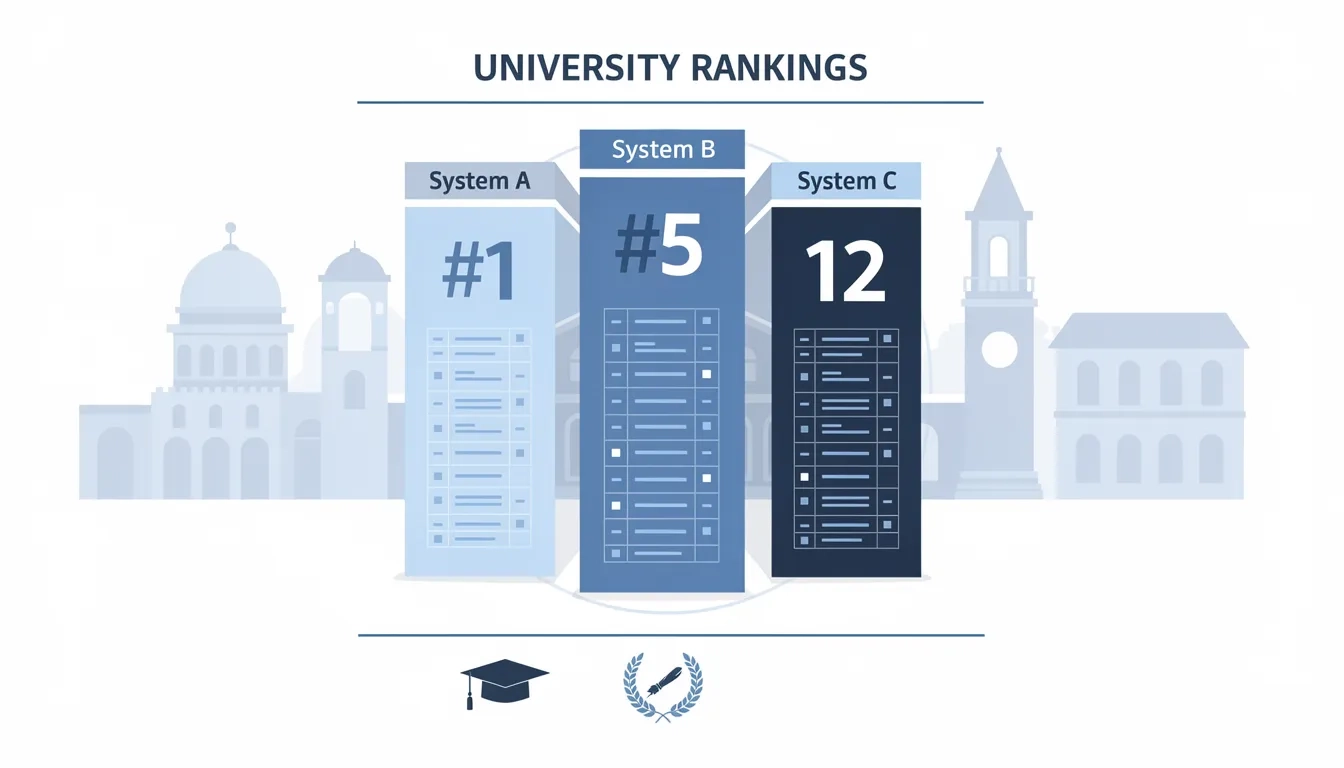
The QS World University Rankings by Subject 2026 put MIT at #1 for physics globally, scoring perfectly in three of its five evaluation indicators. Niche's 2026 list puts Caltech first, Harvard second. US News quietly places Stony Brook University at #39 globally — a number most applicants have never seen. Rankings agree on the names near the top. They fight about the order. And none of them tell you what it actually feels like to spend four years studying physics at any of these places.
Choosing a program based on a single ranking is like buying a car based on its top speed. Technically relevant. Mostly useless for your real life.
How Rankings Work (And What They Don't Tell You)
The major ranking systems use different criteria, which is why the same school can land at #1 on one list and #5 on another. QS emphasizes academic reputation surveys, faculty citations, and employer reputation. Times Higher Education weighs teaching quality, research income, and international outlook across 161 ranked US universities in its 2026 physical sciences methodology. US News global rankings lean heavily on research output.
None of them measure what most undergrad physics students actually care about: Can I get into a research lab before junior year?
The Hidden Metric That Actually Matters
At Caltech, the student-faculty ratio sits at 3:1. That number means more than any ranking position, because you're not competing with 200 classmates for a professor's attention. Caltech's Summer Undergraduate Research Fellowships (SURF) program has been placing undergrads in faculty labs for over 45 years — and students can pursue gravitational-wave experiments through direct SURF placements at LIGO.
MIT runs UROP, the Undergraduate Research Opportunities Program, which connects students with labs across the entire campus. The access is real. Students routinely work alongside Nobel laureates on active experiments, not just coursework.
The Top Tier: What Each School Actually Offers
The consensus across QS 2026, Niche, US News, and Times Higher Education is that a short list of schools occupies its own tier. But they're not interchangeable.
| School | Signature Advantage | Research Access | Best For |
|---|---|---|---|
| MIT | 45+ Nobel-affiliated faculty/alumni, UROP program | National labs, LIGO | Experimental + theoretical breadth |
| Caltech | 3:1 student-faculty ratio, SURF + JPL | LIGO, NASA JPL | Hands-on research from year one |
| Harvard | Flexible curriculum, interdisciplinary options | Harvard-Smithsonian CfA | Theory, astrophysics, interdisciplinary |
| Stanford | Silicon Valley industry ties, photonics strength | SLAC National Lab on campus | Applied physics, industry pipeline |
| Princeton | Princeton Plasma Physics Laboratory next door | PPPL fusion research, REU | Plasma, astrophysics, mathematical physics |
MIT's research culture is nearly a cliché at this point, but it holds up under scrutiny. The Institute has produced 97 Nobel laureates across all fields. The physics building isn't really a building — it's a network of interconnected labs where undergrads show up and get handed real problems.
Caltech's small size is genuinely unusual. With roughly 2,300 total undergrads, it functions more like an intense research institute than a traditional university. Every physics student is expected to engage with research, not just hope for it.
Princeton's proximity to the Princeton Plasma Physics Laboratory (PPPL) gives undergrads access to one of the country's leading fusion research centers. PPPL runs a formal REU program for Princeton students and external applicants alike — and the lab sits a 10-minute drive from campus.
Stanford's location creates a pipeline that's hard to replicate. SLAC National Accelerator Laboratory sits on Stanford land and has hosted 33 Nobel Prizes in its history. If you're drawn toward experimental particle or X-ray physics, that proximity is a serious advantage.
Strong Programs Outside the Famous Five
The school you've heard of most often might not be the best fit. Several programs outside the elite tier offer serious research environments — and better odds of standing out.
UC Berkeley operates Lawrence Berkeley National Laboratory on the hill directly above campus. Berkeley Physics alumni include J. Robert Oppenheimer and Nobel laureate George Smoot. The sheer volume of research running across departments means undergrads who actively look can carve out a niche, even if the competition to do so is real.
University of Chicago leans heavily theoretical. If you want to think hard about physics rather than build experiments, Chicago's intellectual culture is hard to match. Enrico Fermi taught here. The tradition of treating physics as a fundamentally mathematical discipline runs deep, and it shows in how courses are structured from day one.
UC Santa Barbara is underrated, especially in condensed matter and quantum physics. UCSB faculty have won multiple Nobel Prizes in Physics — most recently, Michel H. Devoret and John M. Martinis received the 2025 Nobel Prize in Physics for their work on macroscopic quantum tunneling. The Kavli Institute for Theoretical Physics (KITP) operates on campus, hosting visiting scientists from around the world, and in a 2007 Proceedings of the National Academy of Sciences analysis, KITP ranked first among U.S. non-biomedical research organizations in research impact.
University of Illinois at Urbana-Champaign (UIUC) might be the best value proposition on this entire list. The physics department has close ties to Fermilab and Argonne National Labs, both within a two-hour drive. Illinois physics alumni have led major experiments at CERN. For in-state students, the tuition math makes it almost impossible to argue against.
Here's how these programs stack up on key criteria:
| School | Notable Strength | Key Research Asset | Typical In-State Cost |
|---|---|---|---|
| UC Berkeley | Particle physics, astrophysics | Lawrence Berkeley National Lab | ~$15,000/yr |
| University of Chicago | Theoretical physics | Fermilab (nearby), MRSEC | ~$66,000/yr (private) |
| UC Santa Barbara | Condensed matter, quantum physics | KITP, 2025 Nobel faculty | ~$15,000/yr |
| UIUC | Experimental physics, high-energy | Fermilab + Argonne access | ~$18,000/yr |
| Stony Brook | Broad research, value option | Brookhaven National Lab | ~$11,000/yr |
Stony Brook University earned its highest-ever global physics ranking of #39 in the 2025-26 US News Best Global Universities list — a national rank of #19. For New York state residents, that's a legitimate research-focused degree at a fraction of what a private school costs.
The Liberal Arts Option Nobody Talks About
Most ranking lists skip this category entirely. That's a mistake.
At Swarthmore, Williams, and Amherst, physics programs are small by design. Faculty know your name. Research access is real, not aspirational. At University of Rochester, 77% of students engage in undergraduate research — that's not a marketing line, it reflects how the program is actually structured, with junior and senior thesis work expected rather than optional.
Colgate University funds more than 200 undergraduates each summer to work on faculty research projects. (For context, Colgate has roughly 3,100 total undergrads.) That's a meaningful fraction of the student body doing paid research alongside professors in physics and other sciences.
"The best physics education isn't always the most famous one. It's the one where you're doing physics, not watching it."
If your goal is a PhD, a strong liberal arts program with deep faculty mentorship and real research experience can outperform a large university where you spend two years trying to get a foot in the door. Graduate admissions committees care about research letters and the quality of the work — not just the prestige of the undergrad institution.
How to Match a School to Your Physics Goals
The honest truth: the difference between MIT and Princeton matters less than the gap between either school and one where you never get near a lab. Use this framework.
If you want a physics PhD:
- Prioritize undergraduate research access above everything else
- Look for formal UROP/SURF-style programs or named REU programs
- Ask during campus visits: "How early can freshmen get into labs?"
If you're heading toward industry (tech, finance, quantum startups):
- Stanford and MIT have the most direct pipelines into tech companies
- Consider schools with applied physics tracks alongside pure physics
- UC Berkeley's Bay Area location creates networking advantages few campuses can match
If cost is a real constraint:
- In-state options like UIUC, Stony Brook, and UC schools offer genuine research access at public university prices
- Williams and Amherst are need-blind and meet 100% of demonstrated financial need — worth calculating before assuming they're out of reach
If you're not yet sure physics is your long-term path:
- Harvard and Princeton's flexible curricula let you explore without locking in early
- Chicago's intensity tends to clarify things quickly, in either direction
A few red flags to watch for when evaluating any program:
- Physics faculty with no publications in the last three years (check Google Scholar directly)
- No formal undergraduate research program by name
- Introductory courses taught entirely by TAs with no faculty involvement
- No physics-specific academic advising
The One Thing Rankings Get Wrong About Physics
Here's a position worth stating plainly: single-number rankings are actively misleading for physics applicants, more than for almost any other major.
Physics is divided into wildly different subfields: particle physics, condensed matter, astrophysics, biophysics, quantum computing, atomic/molecular/optical physics. A school ranked #8 overall might be #2 in the world for condensed matter and mediocre in everything else. Rankings collapse all of that into one number and call it done.
The smarter move is to identify which subfield interests you and look at faculty research directly. Drawn to quantum computing? Look at who's publishing in Physical Review X Quantum and which schools those researchers call home. Into astrophysics? Find out which programs have American Astronomical Society-affiliated researchers and active telescope access.
Rankings measure a department. You need to measure whether a specific lab is a place where you can actually grow.
Bottom Line
- For research prestige and access to national labs, MIT, Caltech, and Princeton sit in a tier of their own. The access to LIGO, PPPL, SLAC, and faculty of that caliber is hard to replicate.
- For value and serious research, UIUC and Stony Brook are consistently underestimated. In-state students get real opportunities at a fraction of the cost.
- Don't overlook liberal arts colleges. If Swarthmore, Williams, or University of Rochester fits your learning style, the research mentorship can be better than a large university where you're one face in a 200-person lecture.
- Start by identifying your subfield, then look at faculty research, not just rankings. The single most important question to ask any school: how early can undergrads get into labs?
The school that gets you doing physics on day one beats a famous name on a list every single time.
Frequently Asked Questions
Is MIT or Caltech better for undergraduate physics?
Both are exceptional, but they suit different students. MIT has roughly 4,600 undergrads and covers a broader range of research areas. Caltech's approximately 2,300 total students means an unusually close relationship with faculty, and the expectation of research involvement is built into the culture from the start. Students who thrive in very small, intense environments often prefer Caltech; those who want more variety lean toward MIT.
Do I need to attend a top-10 school to get into a physics PhD program?
No. Physics PhD admissions weigh research experience, letters from faculty who know your work, undergraduate GPA, and (where required) GRE Physics subject scores. A student from Stony Brook or UIUC who spent two years on a real research project with a faculty mentor will be a stronger PhD applicant than someone from a famous school who never got near a lab.
What's the difference between physics and applied physics programs?
Pure physics focuses on understanding fundamental principles — quantum mechanics, general relativity, statistical mechanics — without targeting a specific application. Applied physics channels those principles toward concrete engineering problems: photonics, semiconductor devices, materials science, quantum hardware. Stanford and Caltech both offer distinct applied physics tracks. If you're interested in tech industry careers or quantum startups, applied physics often gives you a more direct path without sacrificing the theoretical depth.
Myth vs. reality: can liberal arts colleges really compete with research universities for physics?
For sheer volume of research happening on campus, no — MIT has more labs running more experiments than any liberal arts college ever will. But for access as an undergraduate, the comparison is much closer than rankings suggest. At University of Rochester (where 77% of students do undergraduate research) or Colgate (which funds 200+ paid summer research positions), you're actually doing physics. At a large research university, you might spend two years trying to get your foot in the door.
When should I start building my college list for physics programs?
Spring of junior year is the right time to start — early enough to evaluate financial aid policies before paying application fees, and to identify specific faculty whose work genuinely interests you. Emailing a professor before applying to ask a sincere question about their research is something fewer than 1 in 20 applicants does, and it gets you remembered in ways a polished application alone cannot.
Which school is best for students interested in quantum computing?
MIT, Caltech, Harvard, and University of Chicago all have dedicated quantum information science centers. But University of Maryland — through the Joint Quantum Institute, a partnership with NIST — is one of the strongest quantum computing research environments in the country, with direct access to NIST researchers and some of the most-cited quantum computing faculty working today. It doesn't always appear on top-10 lists, but the research pipeline there is real.
Sources
- QS World University Rankings by Subject 2026: Physics & Astronomy
- 2026 Best Colleges for Physics - Niche
- Best Colleges for Physics in the US 2026 - Bold.org
- The Best Physics Programs in America - US News
- Undergraduate Research Programs - Caltech Student-Faculty Programs
- Research Opportunities - MIT Physics
- Summer Opportunities - Princeton Physics Department
- SBU in Global Top 40 for Physics by US News
- UCSB Faculty Awarded 2025 Nobel Prize in Physics
- Kavli Institute for Theoretical Physics - UCSB