Best Colleges for Interior Design 2026: A Candid School-by-School Guide
Interior design is one of those fields where the school on your diploma can determine which professional licenses you're eligible to pursue — not just which studios will return your emails. The Bureau of Labor Statistics projects roughly 8,400 new interior design positions opening through 2032. That sounds solid until you consider how many programs are graduating students into those same seats every year. Getting into a recognizable art school is one thing. Getting out with the credentials, contacts, and financial position to actually build a sustainable career is another challenge entirely.
The Accreditation Question Nobody Puts in the Brochure
Before campus tours and rankings, there is one filter worth understanding: CIDA accreditation.
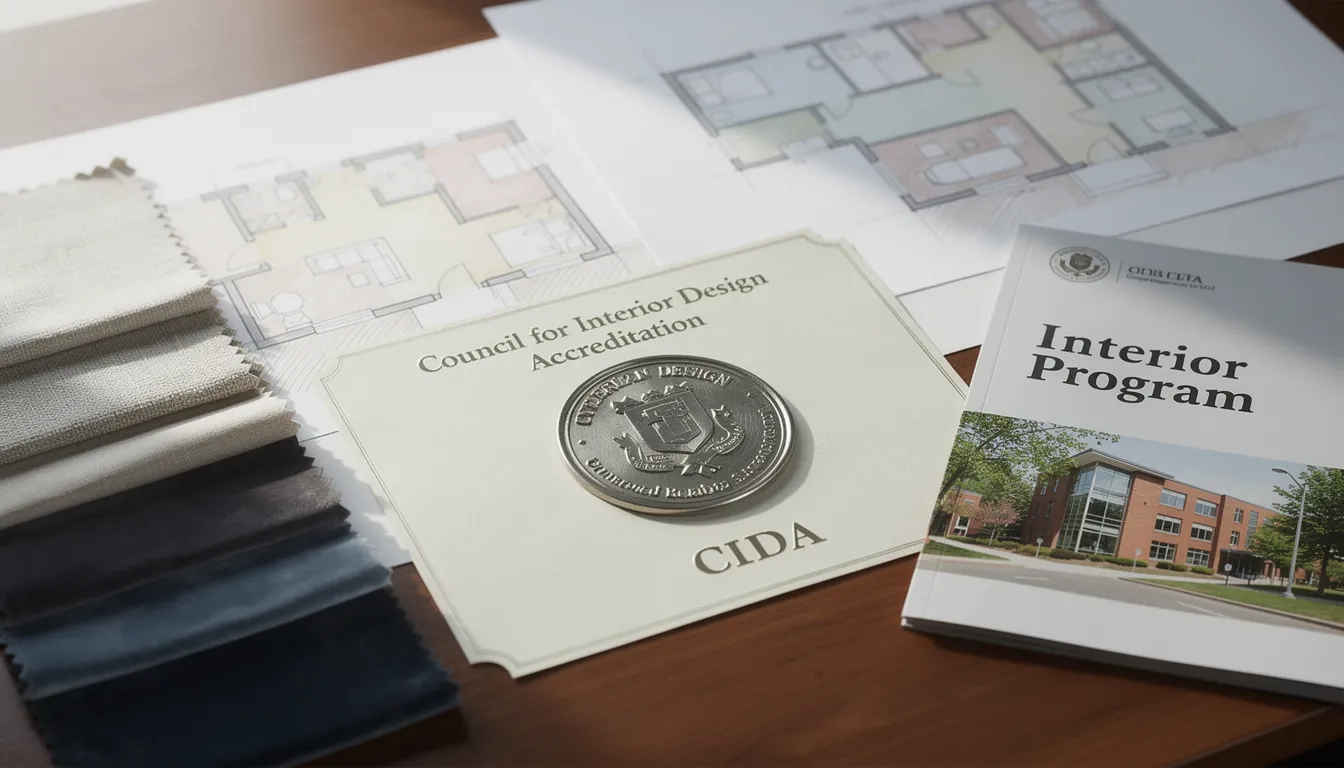
The Council for Interior Design Accreditation maintains over 200 accredited programs serving more than 18,000 students across the US, Canada, and select international institutions. Graduating from a CIDA-accredited school is a prerequisite for the NCIDQ exam in most states — and that exam is what separates a licensed interior designer from someone who arranges furniture. In states like Florida, Louisiana, and Nevada, NCIDQ certification is a legal requirement to call yourself an interior designer at all.
NCIDQ eligibility requires at minimum 60 semester credits from a CIDA-accredited program, plus 3,520 hours of documented professional experience for candidates with a professional-level degree. Graduate from a non-accredited school and you may spend an extra year or two patching together bridge coursework just to reach the starting line everyone else already stands on.
Here's the fine print that glossy brochures skip: some of the most famous art institutions in the country — RISD and Parsons among them — are not CIDA-accredited. Both offer genuine, substantive design education. But a student who enrolls based on name recognition alone, without understanding the accreditation situation, can finish four years and $63,000 in annual tuition to find the most direct licensing path requires additional steps. That's not a dealbreaker. It's a variable that deserves honest pricing before you apply.
"Students enrolled in an accredited interior design program can be confident that the program meets the quality standards recognized by the profession." — Council for Interior Design Accreditation
How the Top Programs Compare
Rankings shift depending on who is doing the asking. DesignIntelligence surveys 9,000+ hiring professionals from more than 4,200 practice organizations. Niche weighs student experience data. US News weights research output. Rather than treat any single list as authoritative, here's a side-by-side comparison built from multiple sources.
| School | CIDA Accredited | Est. Annual Tuition | Degree Options | Notable Strength |
|---|---|---|---|---|
| SCAD | Yes | $41,130 | BFA, MA, MFA | Breadth of specializations |
| NYSID | Yes | ~$33,000–41,000 | AAS, BFA, MFA | Design-only focus, 92% BFA placement |
| Pratt Institute | Yes | $66,600 | BFA, MFA | Studio depth, DesignIntelligence top-ranked |
| Cornell University | Yes | ~$65,000 | BS, MA | STEM-certified, research-forward |
| RISD | No | $63,966 | BFA, MA | Interior architecture, spatial rigor |
| Parsons / The New School | No | ~$60,240 | AAS, BFA, MFA | NYC commercial design networks |
| Drexel University | Yes | ~$58,000 | BS, MS | Paid co-op rotations |
| FIT (CUNY) | Yes | ~$9,700* | AAS, BFA | Best value, Manhattan location |
| University of Cincinnati | Yes | ~$14,500* | BS | Co-op model, 70% placed within 3 months |
| Syracuse University | Yes | $59,138 | BFA, BID | Cross-disciplinary studio approach |
*In-state rate; out-of-state tuition significantly higher
School-by-School Breakdown
SCAD: The Case for Breadth
Savannah College of Art and Design appears near or at the top of DesignIntelligence's annual survey of most-admired design programs more consistently than almost any other school. Its 100 majors and 40 minors give students the flexibility to build combinations that genuinely stand out — interior design paired with branded environments, historic preservation, or lighting design in ways very few institutions allow.
Corporate partnerships are baked into the curriculum rather than offered as optional extras. Students work on real client briefs during studio, so portfolios that arrive at job interviews already contain actual professional work. The online MFA option means working professionals can access the full SCAD curriculum without relocating to Savannah or Atlanta. At $41,130 annually, it sits in the mid-range for private art schools — not cheap, but well below the ceiling.
NYSID: What Singular Focus Produces
The New York School of Interior Design, founded in 1916, is the only college in the country dedicated entirely to interior design education. That focus shapes everything: 573 total students, an 11:1 student-to-faculty ratio, and a faculty drawn almost entirely from active New York practice.
Job placement data from 2023-2024 shows 92% of located BFA graduates employed, with 71% working specifically in interior design. Graduate MFA numbers run higher: 94% employed, with 97% of those in design-related roles. The average NYSID student is 30.1 years old — this school draws a significant share of career changers, which says something about how the industry values a NYSID credential even mid-career. At $1,380 per credit, you're paying for access to one of the most tightly focused design learning environments anywhere.
Pratt Institute: Studio Depth, Brooklyn Edition
Pratt's interior design program costs $66,600 annually and earns consistently strong marks from DesignIntelligence. The graduate program ranked first nationally in 2022. The undergraduate program placed second most-admired in the same survey for three consecutive years — a signal that hiring professionals know and actively seek Pratt graduates.
The curriculum centers on social justice and environmental thinking, not as supplementary themes but as the actual lens through which studio work is structured. Students work on projects addressing community equity and sustainability in the built environment. International study partnerships add another dimension for students who want exposure beyond US markets. For students who want studio intensity and a program with a clear design philosophy, Pratt earns its price.
Cornell: The Research-Oriented Outlier
Cornell is the only Ivy League university with an interior design-adjacent program, housed in the College of Human Ecology's Human Centered Design department. The STEM certification is rare in this field: it affects post-graduation work visa eligibility for international students and signals that research methods are foundational here, not elective.
The approach skews more scientific than the studio-first models at NYSID or SCAD. Students study human spatial behavior, accessibility design, and post-occupancy evaluation alongside traditional coursework. Graduates aiming for evidence-based practice, design consulting, or academic careers will find this structure well-matched. Students who want to start working with residential clients immediately after graduation may find it slower-paced than expected.
RISD and Parsons: Real Schools, Real Trade-offs
Rhode Island School of Design's program is technically called Interior Architecture — and the distinction runs deeper than naming. The program is spatially rigorous, close in character to architecture school, and produces graduates who often pursue exhibition design, adaptive reuse projects, or graduate architecture programs. The caliber of instruction and peer community is difficult to match anywhere.
Neither RISD nor Parsons holds CIDA accreditation. Parsons offers strong commercial design exposure through its New York City location and industry relationships. Both schools lead to excellent careers. Students targeting states with NCIDQ-based licensure requirements should honestly assess whether additional coursework after graduation fits their budget and timeline — because it might.
FIT and University of Cincinnati: The Value Case
Fashion Institute of Technology charges roughly $9,700 in annual tuition for in-state students, holds CIDA accreditation, and operates in Manhattan. That combination is, without exaggeration, the most underrated package on this entire list. Most prospective students scroll past FIT because it doesn't carry the same social cache as SCAD or RISD. The career outcomes data does not support that dismissal.
University of Cincinnati's DAAP (College of Design, Architecture, Art and Planning) runs a co-op model that rotates students through paid professional placements during the degree itself. 70% of graduates report employment within three months of finishing. In-state tuition runs approximately $14,500. Neither school dominates the conversation about top programs, which is largely a marketing problem rather than a quality problem.
Interior Design vs. Interior Architecture: Why the Distinction Matters
This is where more applicants trip up than almost anywhere else in the research process.
Interior design programs — particularly CIDA-accredited ones — prepare students for professional practice and NCIDQ licensure. Interior architecture programs sit structurally closer to architecture school: heavier on spatial theory, materials science, and the cultural dimensions of the built environment.
A RISD Interior Architecture graduate might go on to exhibition design, adaptive reuse work, or an architecture graduate program. A NYSID Interior Design graduate is more likely headed into residential or commercial practice on day one. Neither path is superior — they lead to genuinely different careers. Choosing between them based on prestige rather than where you actually want to end up is an expensive mistake that happens more often than it should.
How to Choose the Right Program
Rather than ranking schools abstractly, match program type to actual career goal.
By intended career path:
- Residential design practice: NYSID, SCAD, Pratt
- Commercial and hospitality design: Parsons, SCAD, Cornell
- Sustainable and social-impact work: Pratt, University of Cincinnati
- Research, academia, or spatial design theory: Cornell, RISD
Questions worth asking every admissions office before applying:
- What percentage of graduates sit for the NCIDQ exam within five years?
- Which firms actively recruit on campus, and can you share recent placement data by firm?
- How many studio hours does a student complete by the end of their second year?
The elephant in the room across all these programs is debt. A student graduating from University of Cincinnati on in-state tuition might carry $60,000 total. The same student at Pratt might owe north of $266,000. Both could land at comparable mid-level firms in year one. But debt load shapes every career decision that follows — the ability to freelance, to take a risk on a smaller studio, to eventually start something of your own. The school name matters far less than most students assume. The debt load matters more than almost any admissions officer will tell you.
Bottom Line
- Check CIDA accreditation first — before prestige, before location, before anything else. It directly affects licensing eligibility in most states.
- SCAD and NYSID lead on career placement and professional-practice preparation. Pratt leads on studio depth and hiring-manager recognition through DesignIntelligence.
- Cornell is the right fit if you want research rigor and an Ivy network. RISD and Parsons are right if you want spatial design breadth — with eyes open about the licensing trade-off.
- FIT and University of Cincinnati are among the strongest value propositions in the field. Their lower profiles reflect marketing gaps, not quality gaps.
- Run real numbers on debt before committing. A school's brand fades from the conversation after your first few years of practice. The loan balance does not.
Frequently Asked Questions
Does CIDA accreditation matter if I'm not planning to get licensed?
More than most students expect. Many larger commercial firms use CIDA accreditation as an informal screening filter for candidates, even for unlicensed positions, because it signals standardized professional training. Anyone planning to eventually go independent or work with commercial clients will also find that the NCIDQ credential signals credibility in ways that simply having a degree from a famous school does not.
What's the real difference between interior design and interior architecture as a major?
Interior design programs, especially CIDA-accredited ones, train students for professional practice and licensure. Interior architecture programs are closer in structure to architecture school — emphasizing spatial theory, construction systems, and design's cultural and historical context. RISD offers Interior Architecture; NYSID and SCAD offer Interior Design. The distinction affects both the licensing path and the type of work you'll be best prepared for on graduation day.
Is SCAD worth the higher cost compared to a public option like FIT?
That depends entirely on goals and financial situation. SCAD's breadth of specializations, corporate partnerships, and online program options are genuine advantages that FIT can't match. But FIT's CIDA-accredited program at CUNY tuition rates, located in Manhattan, is a legitimately strong alternative for students focused on minimizing debt without sacrificing access to the New York design market. The honest answer is that both produce working designers — the difference is $120,000+ in debt.
Can I become a licensed interior designer after attending RISD or Parsons?
Yes, but the path requires extra steps. Since neither school holds CIDA accreditation, graduates typically need to complete additional coursework at a CIDA-accredited institution to satisfy the 60-semester-credit requirement for NCIDQ eligibility. Some graduates do this; others choose not to pursue licensure and build strong careers regardless. The key is knowing about this before enrolling, not after.
What should a strong interior design portfolio include for top school admissions?
Most programs want evidence of spatial thinking — floor plans, elevations, perspective sketches — alongside any fine art, photography, or design work that demonstrates visual sensibility. SCAD and Pratt both look for students who can articulate their ideas in writing and in conversation, not just visually. A portfolio showing process (rough sketches, iterations, material explorations) typically outperforms one showing only polished final renderings, because process reveals how you think.
Is there a meaningful salary difference between graduates of top-ranked vs. lower-ranked programs?
Early-career salaries in interior design cluster tightly regardless of school name — the Bureau of Labor Statistics pegs the median annual wage for interior designers at around $62,000, with significant variation by specialty and geography. The bigger salary differentiators are the city where you work, whether you specialize in commercial over residential, and how quickly you build a client base. School name helps with the first job. After that, portfolio and relationships do most of the work.
Sources
- CIDA Accredited Programs Directory
- New York School of Interior Design — At a Glance
- BLT Awards — Top 10 Interior Design Schools Redefining Aesthetics
- Design Manager — Top Interior Design Schools in the US
- PrepScholar — 10 Best Interior Design Schools in the US
- Pratt Institute — DesignIntelligence Survey Rankings