Best Colleges for Art History Majors 2026: Where to Actually Go
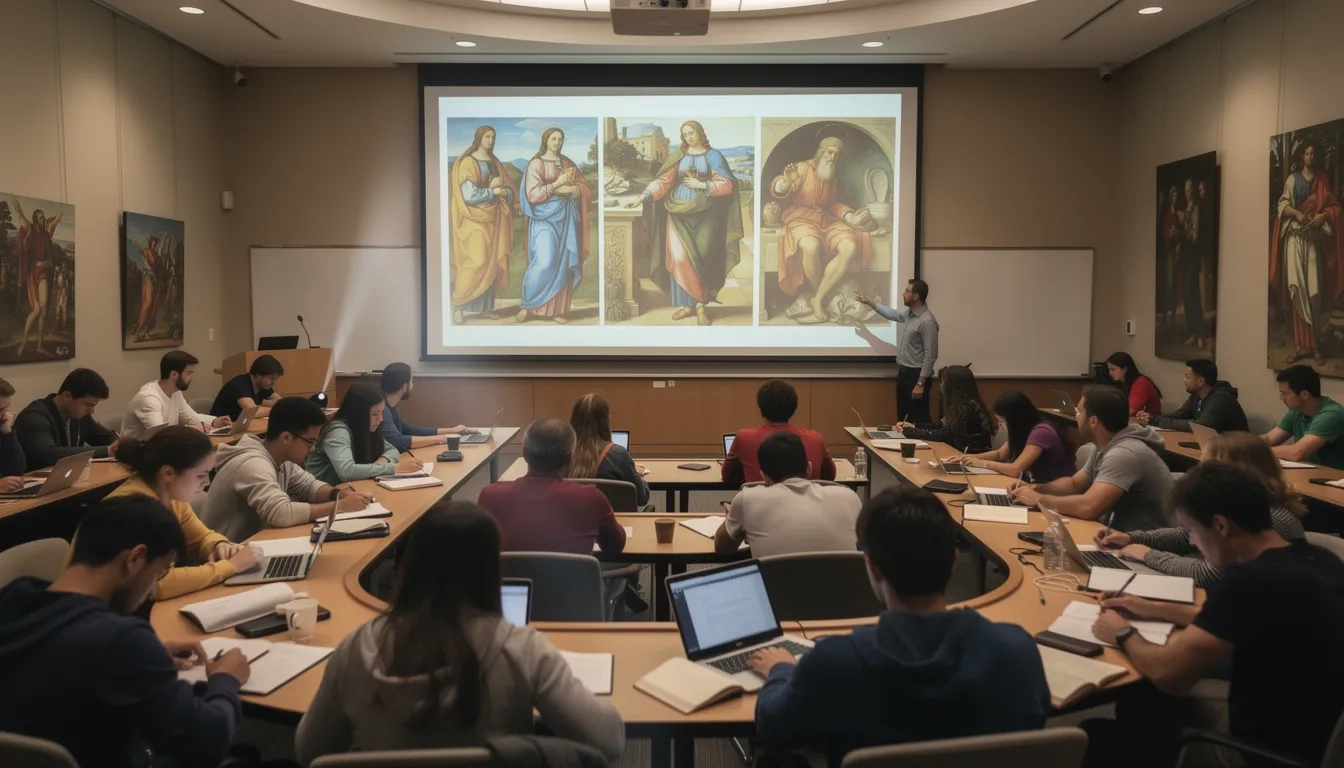
Art history has a reputation problem. Somewhere between "just looking at paintings" and "unemployable humanities degree," the field gets undersold by guidance counselors who've never checked where graduates actually land. Christie's. Sotheby's. The Smithsonian. Google's brand team. Cultural property law firms. Art history graduates are in all of those places, and they're doing fine.
The degree itself teaches close reading, visual analysis, archival research, and historical argument — skills that hold up across industries. But choosing the right program matters more than most applicants realize. Faculty depth, campus collections, city location, and career pipeline vary enormously from school to school.
What Separates a Strong Art History Program From a Weak One
Before looking at specific schools, it's worth knowing which factors actually predict a quality experience.
Faculty coverage is what you're really buying. Art history spans ancient, medieval, Renaissance, early modern, 19th century, modern, contemporary, Asian, African, Latin American, and Islamic traditions. A department with three professors covering all of that is not a strong department. You need specialists, and you need enough of them that you can find a thesis advisor who actually knows your period.
On-campus collections change how you learn. Access to real objects — not slides, not digital scans — transforms art historical study. Schools like Yale and Harvard have university art museums that let undergraduates engage with primary sources in ways that most institutions simply can't match. That kind of hands-on contact with physical works matters, especially for students considering conservation or curatorial careers.
Location sets your ceiling for opportunities outside the classroom. New York, Chicago, and Washington D.C. give you internship access that rural campuses can't replicate. The difference isn't just convenience — it's whether you graduate with museum experience or without it.
Graduate program strength is a useful proxy, even for undergrads. Strong doctoral programs attract strong faculty. And at most universities, those faculty also teach undergraduate seminars. A school without a serious art history PhD program often has thinner faculty and a weaker alumni network.
The Ivy League Tier
These programs attract the deepest faculty, hold the best collections, and produce graduates who end up in curatorial leadership, academic positions, and senior institutional roles.
Yale University sits at the top of most serious rankings. The Department of the History of Art is one of the oldest in the country, and two major institutions sit steps from campus: the Yale University Art Gallery (founded in 1832, the oldest university art museum in the Western Hemisphere) and the Yale Center for British Art, which holds the largest collection of British art outside the United Kingdom. Undergraduates can conduct original research with primary objects as part of standard coursework. Faculty coverage spans Byzantine art through contemporary practice.
Harvard University offers perhaps the broadest on-campus resources anywhere in the country. Three art museums — the Fogg, the Busch-Reisinger, and the Arthur M. Sackler Museum — collectively hold over 250,000 objects. The Art, Film, and Visual Studies program weaves together cultural theory and traditional art historical inquiry. Harvard's alumni network inside the museum world is dense and actually useful to recent graduates.
Columbia University runs one of the largest art history departments in the United States. The Columbia-Barnard program has specialists spanning ancient Mesopotamia to contemporary global art. Being based in New York City means the Metropolitan Museum, MoMA, the Guggenheim, and dozens of commercial galleries are all viable internship and employment targets. Some Columbia students land Met internships during junior year and convert them into post-graduation roles.
"The best art history education happens between the classroom and the museum floor. Schools that give you both change how you see everything."
Princeton's Department of Art and Archaeology takes a genuinely distinct approach. The program blends art history with archaeology, pushing students toward material culture and physical evidence alongside written sources. The emphasis on writing and original research is serious. Princeton University Art Museum, which completed a major expansion in 2023, gives students access to works from across world history in an intimate setting.
Programs Worth Knowing Beyond the Ivies
NYU's Institute of Fine Arts is primarily a graduate institution, but NYU's undergraduate art history program benefits from IFA faculty and from its address: the IFA townhouse on the Upper East Side sits directly across the street from the Met's main entrance. For students interested in conservation or museum studies, few programs are better physically positioned.
The University of Chicago offers something the Ivies can't: the Art Institute of Chicago — one of the greatest encyclopedic museums in the world — is about 10 minutes south by train. UChicago's faculty leans heavily on critical theory and interdisciplinary approaches. The Neubauer Collegium for Culture and Society also funds undergraduate research projects in the arts, which is a legitimate differentiator.
George Washington University is built into the Smithsonian's gravitational field. The National Mall is a 15-minute walk from campus. GW has formal partnerships with Smithsonian institutions, and undergraduates regularly land positions as curatorial assistants at the National Gallery of Art and the Freer|Sackler. For students drawn to American art, decorative arts, or museum policy specifically, it's one of the most practically connected programs in the country.
UC Berkeley ranks second in North America for art history research output, according to EduRank's March 2026 update — an analysis based on 4.48 million citations from 373,000 academic papers. The department has particular strength in Asian art history, 20th-century American art, and critical theory. Bay Area proximity means access to SFMOMA, the Asian Art Museum, and the de Young. For students who want rigorous research training at public university tuition rates, Berkeley is the clear answer.
One genuinely surprising finding from EduRank: UNC Chapel Hill ranks #1 in North America for art history research performance. The methodology weights scientific citation outputs heavily, which inflates institutions with cross-disciplinary art-science research. That caveat noted, Chapel Hill has a serious department, ACC consortium access, and dramatically lower tuition than any school above it on this list.
Top Programs at a Glance
| School | Location | Standout Feature | Best For |
|---|---|---|---|
| Yale | New Haven, CT | Two major on-campus museums | Research, academia |
| Harvard | Cambridge, MA | 250,000+ object collection | Breadth, global scope |
| Columbia | New York, NY | NYC museum access | Curatorial, museum careers |
| Princeton | Princeton, NJ | Art & Archaeology blend | Writing, material culture |
| NYU | New York, NY | Met proximity, IFA faculty | Conservation, curatorial |
| Univ. of Chicago | Chicago, IL | Art Institute of Chicago | Theory, critical approaches |
| George Washington | Washington, D.C. | Smithsonian partnerships | American art, museum policy |
| UC Berkeley | Berkeley, CA | Top research output, public tuition | Asian art, theory |
| UNC Chapel Hill | Chapel Hill, NC | #1 research ranking, low cost | Research at public price |
What Art History Graduates Actually Do
The career question deserves a real answer, not a deflection.
The numbers are better than the stereotype. According to the Bureau of Labor Statistics, curator and archivist roles are projected to grow 12% from 2021 to 2031 — faster than most professional fields. The average art historian earns around $57,100 per year, with experienced curators and professors pulling $80,000 to $86,780 at the median. Entry-level positions at museums or galleries typically start between $38,000 and $42,000.
But museums are only part of the story. Art history graduates land at auction houses, brand strategy firms, publishing companies, cultural property law practices, and tech companies that need visual researchers. Christie's and Sotheby's recruit directly from art history programs. At least one major consulting firm has internally noted that art history graduates tend to excel at visual presentation and communication — the kind of work that fills most slide decks.
Realistic career paths for art history graduates:
- Museum and gallery roles: curator, registrar, educator, collections manager
- Auction houses: specialist, cataloger, client advisor
- Art law and cultural property: paralegal, policy researcher
- Education: secondary and post-secondary teaching
- Publishing and media: criticism, editorial, communications
- Tech and brand: visual research, content strategy, creative direction
- Graduate school: MA or PhD for academic or senior museum roles
The honest caveat: curatorial positions at major museums are competitive and increasingly require graduate degrees. Students serious about that path should prioritize programs with direct museum internship pipelines — Columbia, NYU, and GW have structural advantages that smaller or more rural schools don't.
How to Actually Choose the Right Program
Chasing the name on the sweatshirt is a trap. A well-connected, engaged student at George Washington will often outperform a disengaged one at Yale. The real question isn't "which school is best?" but "which program fits how I learn and where I want to end up?"
A decision framework:
- Academic/curatorial leadership path → prioritize faculty depth and collections. Yale, Harvard, Princeton.
- Museum or auction house career → prioritize city location and institutional partnerships. Columbia, NYU, GW.
- Specific tradition (Asian art, Islamic art, Latin American) → research individual faculty first. Hire your professor, not your school.
- Public university budget → Berkeley, UNC Chapel Hill, and the University of Washington all offer serious programs at state tuition rates.
- Studio practice alongside art history → the Brown/RISD dual degree is genuinely rare: liberal arts rigor combined with serious studio training in one program.
Visit during the semester, not over summer. A department that hums with activity in March can feel abandoned in July. Sit in on a seminar if the school allows it. Talk to juniors and seniors, not just the admissions office. Ask specifically which faculty teach undergraduate seminars — some departments hide senior scholars in graduate-only courses, and you deserve to know before you enroll.
Students who begin building their college list in the spring of 11th grade can evaluate financial aid policies and research individual faculty before application fees are paid — a small investment of time that tends to pay off.
Bottom Line
- Location matters more than most rankings capture. Programs in New York, Chicago, and D.C. offer museum internship pipelines that schools in smaller cities simply cannot match.
- Faculty coverage is the core purchase. Look at who teaches undergraduate seminars, not just who's listed on the department page.
- Yale, Harvard, Columbia, and Princeton offer the deepest combinations of faculty, collections, and alumni networks — but they're not the only serious options.
- For public university programs, UC Berkeley and UNC Chapel Hill outperform their name recognition on research metrics.
- Art history graduates have more options than the degree's reputation suggests. The major works across museums, law, tech, publishing, and consulting — especially when paired with targeted internships and a clear sense of direction.
Frequently Asked Questions
Is art history a good major for finding a job?
Art history builds transferable skills: visual analysis, research, written argument, and historical context. Graduates work in museums, auction houses, law firms, tech companies, and consulting. The Bureau of Labor Statistics projects 12% growth for curator and archivist roles through 2031. The degree works best when paired with internship experience and a realistic sense of which career entry points are actually available.
Do you need an Ivy League school to study art history?
No. George Washington University, UC Berkeley, and the University of Chicago all produce graduates who compete directly for curatorial and museum roles with Ivy League alumni. Location, faculty specialization, and your own initiative matter more than the name on the diploma. That said, Yale, Harvard, and Columbia have alumni networks inside the museum world that are unusually dense and can open specific doors.
What is the difference between art history and art conservation?
Art history focuses on the interpretation, historical context, and cultural meaning of visual art. Art conservation is a technical discipline focused on the physical preservation and restoration of artworks. Some programs — particularly NYU's Institute of Fine Arts — offer pathways into conservation studies. Most conservation graduate programs require a background in both art history and natural sciences (chemistry especially), so planning ahead matters.
Which school is best for studying Asian art history specifically?
UC Berkeley has one of the strongest Asian art history faculties in the country, with proximity to the Asian Art Museum of San Francisco. Harvard's Arthur M. Sackler Museum collection is also a significant resource, and the faculty there spans Chinese, Japanese, and South Asian traditions. For graduate study, Yale's East Asian art history program has produced a substantial number of leading scholars in the field.
How do financial aid packages affect the real cost of elite art history programs?
Private universities like Yale, Harvard, and Columbia post tuition and fees around $63,000 to $66,000 per year (2025-2026 rates), but all three meet 100% of demonstrated financial need. For many middle-income families, the net cost after aid is competitive with or lower than flagship state universities. UC Berkeley's in-state tuition runs about $14,312 annually. Running the Net Price Calculator at each school before dismissing it based on sticker price is worth the 20 minutes.
Should I consider graduate school in art history?
For academic careers and senior curatorial positions at major institutions, a master's degree or PhD is effectively required. But graduate school in art history is highly competitive, and funded PhD positions are limited. The stronger path for many students is to get curatorial experience during and immediately after undergrad — internships, assistant roles, registrar positions — before deciding whether a graduate degree is necessary for the specific career you want.
Sources
- 2026 Best Colleges with Art History Degrees in America - Niche
- United States' Best Art History Colleges Rankings - EduRank
- Top Art History Programs in the US - CollegeVine
- 2026 Art History Careers: Guide to Career Paths, Options & Salary - Research.com
- The 15 Best Art Schools in the U.S. 2026 - Art & Object
- The Best Art History, Criticism and Conservation Colleges 2026 - College Raptor