3 big takeaways from CIC’s Presidents Institute
ORLANDO, Fla. — College presidents have a lot on their plates this year.
They’re grappling with the public questioning the value of college, conservative attacks on diversity, equity and inclusion programs, and new laws that will reshape the federal lending system.
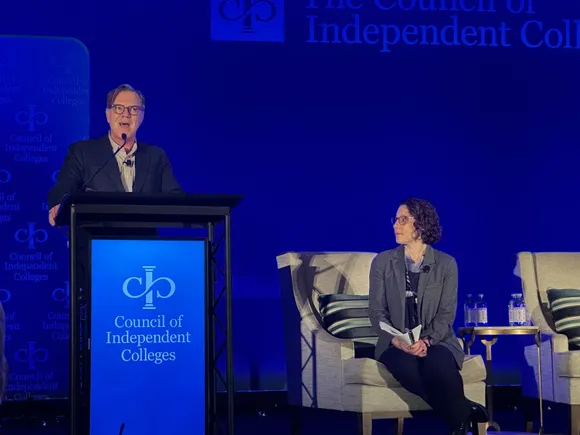
Higher education experts discussed all those issues and more last week at the Council of Independent Colleges’ Presidents Institute, an annual gathering that brings together hundreds of leaders of private nonprofit colleges. Below, we’re breaking down insights from higher education experts and college leaders on those topics.
Higher ed is entering a new era
U.S. universities have long operated under an “implicit agreement” with American society, according to a 2025 policy brief from Stanford University researchers.
“In exchange for public funding, autonomy, and prestige, even nominally private institutions provided many services to society,” they wrote. “Universities helped settle frontiers, fight world wars, and, through economic and education policies like the GI Bill, grow the middle class. Their research advanced national interests, their teaching developed human capital, and their civic engagement strengthened communities.”
But this relationship has frayed in recent years.
Under half of surveyed Americans expressed high confidence in U.S. colleges, according to polling last year from Gallup and the Lumina Foundation. And the Trump administration has threatened the decades-long relationship between the federal government and research universities by suspending or canceling vast sums of their funding.
Now, universities must negotiate a new academic social contract with society, Emily Levine and Mitchell Stevens, both education professors and co-authors of the 2025 paper, told Presidents Institute attendees. They pointed to other points in history where this social contract changed, such as the vast government investments into higher education amid the WWII and Cold War eras to create a skilled workforce.
“What I’d offer historically is not a rise and fall story so much, but one of crisis and response, where at every new juncture, a new academic social contract is forged to respond to that crisis,” Levine said. “There’s no doubt that we’re in the midst of the latest crisis, but we haven’t yet forged that response.”
Levine and Stevens argued that colleges and universities are particularly well-positioned to take on some of society’s biggest challenges. Stevens, for instance, argued that colleges could do more to educate workers throughout their careers, especially as artificial intelligence threatens to disrupt the workplace.
“That means that people are going to have to be educated and re-educated over the entire arc of their lives,” Stevens said.
Colleges could also refocus on their relationships with local communities, following decades of emphasis on global reach, Levine said.
“But we might suggest that they’re equally, if not more, valuable as engines in their local community, right?” Levine said. “In addition to getting bigger, we might be thinking about getting smaller, which I think is where your institutions have the edge, refocusing on the contracts with their immediate neighbors.”
Colleges are being forced to reconsider their diversity work
For years, conservative politicians have targeted diversity, equity and inclusion initiatives at colleges. In 2023, Florida banned DEI spending across all of its public colleges. Since then, lawmakers in many other states have passed similar legislation banning or curtailing such work.
The anti-DEI crusade reached a fever pitch last year, when the Trump administration began threatening colleges’ funding over their diversity work.
Eboo Patel, founder and president of Interfaith America, a nonprofit focused on pluralism, told CIC attendees on Tuesday that diversity work is about two things: “the empowerment of minorities and cooperation across difference.”
But Patel pointed to a 2016 article in the Harvard Business Review, which concluded that “most diversity programs aren’t increasing diversity,” a finding based on three decades of data from more than 800 firms in the U.S.
The authors — Frank Dobbin, a sociology professor at Harvard University, and Alexandra Kalev, a sociology and anthropology professor at Tel Aviv University — explored which kinds of diversity initiatives did and did not work.
Mandating diversity training for company managers didn’t increase the share of more minority managers five years later, they found. Voluntary training, however, did lead to more minority managers, the pair wrote.
Dobbin and Kalev also wrote that formal grievance procedures and compulsory trainings could actually make things worse. Instead, interventions such as targeted college recruitment and mentoring programs boosted diversity at firms, their research showed.
Yet in a 2024 interview with The Chronicle of Higher Education, Dobbin lamented that college leaders didn’t appear to look at the pair’s research.
“This work will either be reformed by people who love it following the evidence, or will be destroyed by people who hate it. Choose.”

Eboo Patel
Founder and president, Interfaith America
On Tuesday, Patel argued that leaders should be paying attention to those critiquing diversity work in good faith.
“There are people out there who are looking for the bath water to be dirty so they can throw out the baby,” Patel said. “Those are not people who have a ton of intellectual credibility. I would pay a lot of attention to the people who love diversity work, who are saying, ‘We got this really wrong, and we are saying it because we love it.’”
He added, “This work will either be reformed by people who love it following the evidence, or will be destroyed by people who hate it. Choose.”
Leaders are looking to workforce development
College leaders are bracing for major changes to the federal lending landscape, including the end of Grad PLUS loans and new caps that will impose lifetime borrowing limits of $100,000 for most graduate degrees and $200,000 for professional programs.
Despite these challenges, many college leaders are optimistic that they can home in on workforce development.
“All of us are involved in workforce development — real, substantive workforce development for our communities,” Bryon Grigsby, president of Moravian University, told Higher Ed Dive last week.
To that end, the Pennsylvania institution recently announced it will launch an aviation management program this fall, with plans to add an air traffic control program at a later date.
Walter Iwanenko Jr., president of Gannon University, another Pennsylvania institution, likewise said the four-year sector has an opportunity to “dive into” the world of work-based learning and two-year certifications.
Indeed, short-term programs have recently seen greater enrollment increases than four-year offerings, according to preliminary data from the National Student Clearinghouse Research Center. Enrollment grew 6.6% in undergraduate certificates and 3.1% in associate programs in fall 2025 compared to the prior year. That’s compared to 1.2% enrollment growth in bachelor’s programs.